


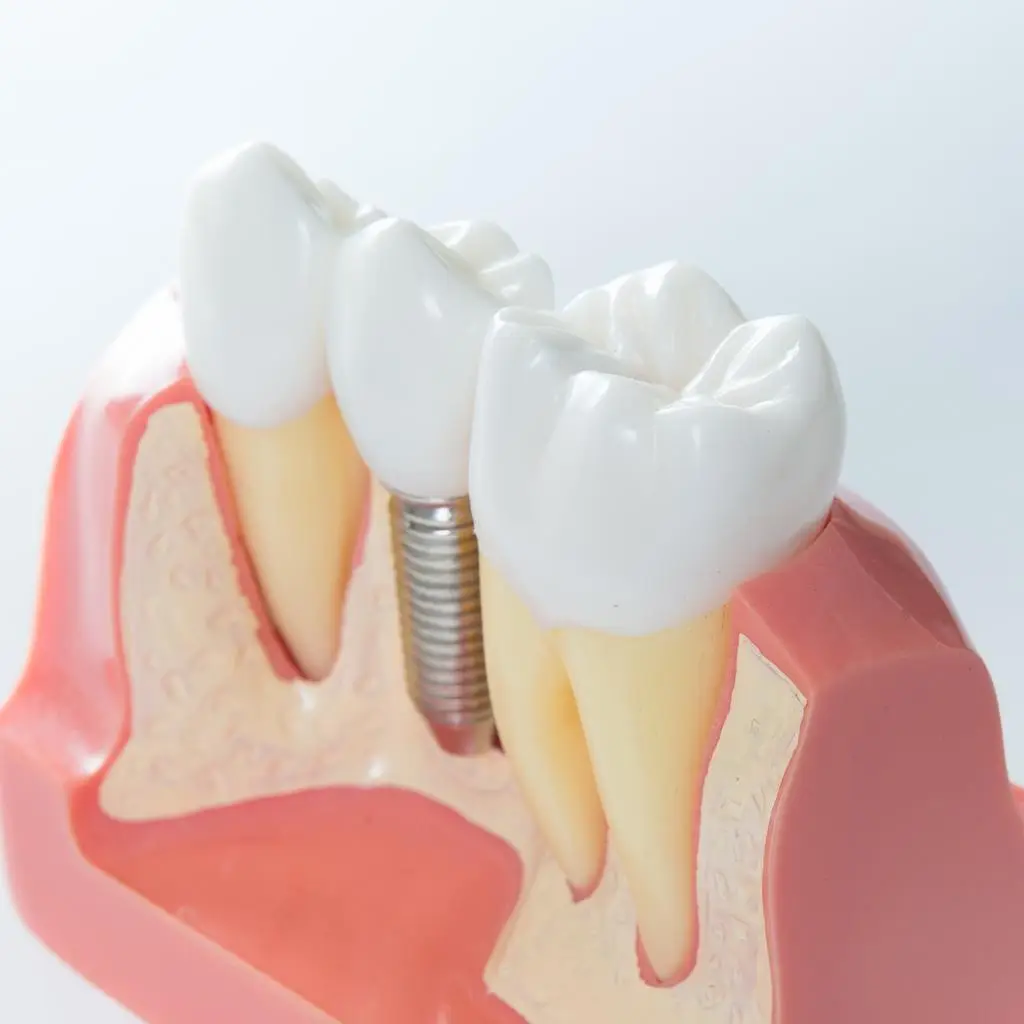
A dental implant is intended as a long-term solution for replacing a missing tooth. But does that also mean an implant will last for the rest of your life?
Unfortunately, there is no fixed number of years for this. A well-placed and well-maintained implant can function for many years, but the lifespan varies per person. The condition of the jawbone and gums, oral hygiene, smoking, general health, and the load on the implant all play a role.
Furthermore, an implant treatment consists of different components. The implant in the jawbone can still function excellently while the crown on top of it may need to be repaired or replaced over time.
In this article, we explain which factors influence the lifespan of a dental implant and what you can do yourself to keep an implant healthy for as long as possible.
What is a dental implant?
A dental implant is an artificial root placed in the jawbone to replace a missing tooth.
An implant is usually made of titanium or a titanium alloy. After placement, the implant is given time to bond with the surrounding bone. This process is called osseointegration.
When the implant is sufficiently stable, a dental construction can be attached to it.
When replacing a single tooth, this usually consists of a connecting element, the abutment, with a crown on top.
Implants can also be used to support a bridge or a removable dental prosthesis, such as overdentures.
How long can an implant last?
An implant does not have a fixed expiration date.
When the implant is well-integrated into the bone and the surrounding tissue remains healthy, it can function for a long time. This can be decades, but lifelong operation can never be guaranteed.
Scientific research on implants is also usually conducted over specific study periods. Therefore, it is more prudent to speak of long-term survival and functioning than to promise that an implant will last a certain number of years.
How long an implant will function for one specific patient cannot be exactly predicted in advance.
Does the crown on an implant last just as long?
Not necessarily.
The implant in the jawbone and the crown above it are two different components.
The crown is subjected to daily stress during eating, chewing, and potentially grinding or clenching. Over time, wear or damage may occur. A screw connection may also require attention.
As a result, it is possible that the implant itself is still firmly in the jawbone, while the crown needs to be repaired or replaced.
This does not automatically mean that the implant is lost.
Which factors determine the lifespan of an implant?
Long-term success is influenced by several factors.
A key factor is the health of the gums and bone surrounding the implant. Good daily oral care and professional aftercare are therefore important.
In addition, smoking, certain general health factors, previous gum problems, and the load on the implant can have an influence.
The position of the implant and the construction placed on it also play a role.
The initial situation and risks must therefore be carefully assessed before placing an implant.
How important is oral hygiene with an implant?
Very important.
An implant itself cannot get a cavity because it does not consist of natural tooth tissue. However, the gums and jawbone around the implant can become inflamed.
Dental plaque can also accumulate around an implant.
Therefore, an implant must be cleaned carefully every day, just like natural teeth.
In addition to brushing, supplementary cleaning around the implant may be necessary. Which tools are suitable depends on the shape of the crown and the space around the implant.
A dental hygienist can provide personal advice on this.
Can you get an inflammation around an implant?
Yes.
A superficial inflammation of the soft tissue around an implant is called peri-implant mucositis.
When progressive loss of the supporting bone around the implant also occurs, we refer to it as peri-implantitis.
Signs can include bleeding or swollen gums, pus, an unpleasant taste, or changes around the implant.
The problem is that inflammation around an implant does not always cause pain.
Therefore, check-ups remain important, even when the implant itself feels fine.
What is peri-implantitis?
Peri-implantitis is an inflammatory process around an implant where the supporting bone is also affected.
As this process progresses, more and more bone around the implant can be lost. Ultimately, this can affect the stability and prognosis of the implant.
The risk varies per person. A history of periodontitis and smoking can be important points of attention, for example.
The goal is therefore not only to treat problems when they arise, but primarily to keep the tissue around the implant healthy in the long term.
How do you notice if something is wrong with an implant?
A problem with an implant does not necessarily cause immediate pain.
Watch for bleeding or swollen gums around the implant, pus, a foul taste or odor, changes in the gums, or a crown that suddenly feels different.
An implant that moves itself must always be assessed.
Even if you have no complaints, changes around an implant can sometimes be discovered during a check-up.
Therefore, do not wait exclusively for pain.
Does smoking influence dental implants?
Smoking is a major risk factor in implantological treatment.
It can affect healing after placement and is associated with a higher risk of complications around implants.
If you smoke and are considering an implant, it is therefore wise to discuss this with your practitioner beforehand.
Quitting smoking is not only beneficial for your general health but can also be beneficial for oral health and the prognosis of an implantological treatment.
What if you grind or clench your teeth?
An implant and the crown on top of it are loaded during chewing.
In people who grind or clench heavily, greater forces can be placed on the crown, screw connection, and surrounding construction.
This does not automatically mean that someone who grinds cannot receive an implant. It is, however, a factor that the dentist or implantologist must include in the treatment plan.
In certain situations, a protective device for the night may be considered after treatment.
How do you care for a dental implant?
An implant requires ongoing daily care.
Brush carefully around the implant twice a day and pay special attention to the transition between the implant crown and the gums.
Depending on the construction, interdental brushes or other tools may be needed to keep hard-to-reach places clean.
Seek advice from your dentist or dental hygienist. For example, an interdental brush that is too small will not clean sufficiently, while an unsuitable tool can be difficult to use.
Good implant care is therefore more than just brushing your teeth twice a day.
How often should an implant be checked?
There is no check-up interval that is the same for every patient.
How often check-ups and professional aftercare are needed depends, among other things, on the health of the gums, oral hygiene, previous periodontitis, general risk factors, and the condition of the implant.
During check-ups, the gums around the implant, the cleanability, and the stability and condition of the implant construction can be examined.
When there is reason to do so, additional measurements or X-rays may be necessary to assess the bone level, for example.
Can an implant be replaced if it is lost?
Sometimes, but not always immediately.
When an implant is lost, it must first be investigated why this happened and how much healthy bone and soft tissue is still present.
Depending on the cause and initial situation, an implant can sometimes be placed again. In other situations, bone augmentation or another treatment may be required first.
Another way to replace the missing tooth may also be more prudent in some cases.
A new implant is therefore not automatically the next step.
Implant, bridge, or do nothing?
An implant is not the only possibility for replacing a missing tooth.
Depending on the situation, a bridge or removable device can also be considered. In some cases, a missing tooth does not necessarily even have to be replaced.
An advantage of an implant is that adjacent teeth usually do not need to be prepared as pillars, as is the case with a traditional tooth-supported bridge.
On the other hand, implant placement is a surgical treatment and sufficient healthy bone and gums are required.
The best solution therefore differs per patient.
How can you best support the lifespan of an implant?
You have the most influence by taking good care of the implant and the surrounding gums.
Brush carefully every day, clean between the implant crown and adjacent teeth where necessary, and follow the advice of your dentist or dental hygienist.
In addition, have the implant checked periodically, even if you have no complaints.
Do you smoke, have you had periodontitis before, or do you grind your teeth? Discuss this with your practitioner, as these can be relevant points of attention for aftercare.
An implant should therefore not be seen as something you never have to look at again after placement.
Have an implant assessed in Leiden
Are you missing a tooth and want to know if an implant could be a suitable solution?
At We Smile Tandartsen in Leiden, we can examine your teeth and discuss the various options for replacing a missing tooth with you.
If implantological treatment seems appropriate, we can refer you to an implantologist or oral surgeon for further assessment and potential placement of the implant.
After implantological treatment, good daily oral care and professional check-ups remain important for keeping the implant and surrounding tissue healthy.
Would you like to know which solution is suitable for a missing tooth? Then make an appointment for personal advice.