


A whiter smile is attractive to many people, but before you start whitening, an important question arises: is teeth whitening bad for your teeth?
Teeth whitening does not have to be harmful when performed responsibly and with suitable whitening agents. However, temporary side effects can occur during a whitening treatment, with sensitive teeth and gum irritation being the most common.
It is therefore wise not to simply start with any random whitening product. First, it must be assessed whether your teeth are healthy, what is causing the discoloration, and whether whitening is appropriate for your situation.
In this article, we explain what happens during whitening, which side effects may occur, and how you can have your teeth whitened safely.
How does teeth whitening work?
Professional teeth whitening usually involves the use of a whitening gel based on hydrogen peroxide or carbamide peroxide.
The active substance penetrates the tooth tissue and reacts with pigments in the tooth. This allows teeth to become lighter without the need to grind away tooth tissue.
Carbamide peroxide breaks down during the whitening process, releasing hydrogen peroxide, among other things. Therefore, different whitening products may state different percentages while ultimately working according to a similar principle.
The result develops gradually and varies per person.
Does teeth whitening damage tooth enamel?
This is likely the most important question.
With professionally supervised whitening using suitable products, the tooth enamel does not simply have to be “bleached away” or ground down. Whitening works differently than abrasive agents that attempt to mechanically remove surface stains.
This does not mean that every whitening agent is automatically safe at every concentration and duration of use. The composition, concentration, contact time, and frequency of use are important.
Therefore, Dutch oral care professionals advise performing whitening under the supervision of a dentist or dental hygienist.
Why can teeth become sensitive during whitening?
Tooth sensitivity is one of the most common side effects of whitening.
The active whitening agent can diffuse through the enamel and dentin. This can cause a temporary reaction of the tooth nerve.
For example, you may experience short, sharp sensitivity to cold air or cold drinks.
How sensitive a person becomes varies greatly per individual. The concentration of the whitening agent and the duration of exposure can also play a role.
The sensitivity is usually temporary and typically subsides after the whitening is interrupted or terminated.
What should you do if your teeth become sensitive?
Do your teeth become clearly sensitive during the whitening process? Do not automatically start whitening more or for longer to get faster results.
Depending on the severity of the symptoms, it may be wise to temporarily stop or adjust the whitening schedule.
Certain products for sensitive teeth may also be recommended.
If you have a lot of pain, if the sensitivity persists, or if one specific tooth seems much more sensitive than the others, please contact the dentist. There may be another cause for the pain.
Can whitening gel damage the gums?
Whitening gel should remain on the teeth as much as possible and should not come into contact with the gums for an extended period.
Contact between peroxide-based whitening gel and the gums can cause temporary irritation. Along with tooth sensitivity, this is one of the most common side effects of teeth whitening.
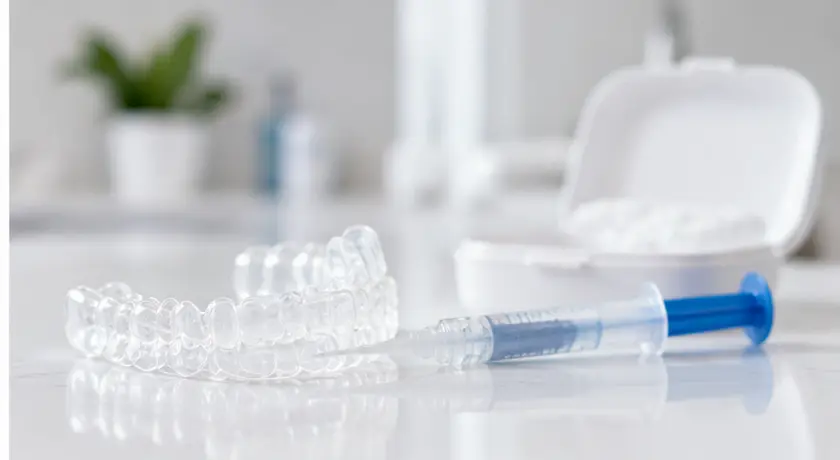
A well-fitting whitening tray helps to apply the whitening agent in a controlled manner and limit unnecessary contact with the gums.
Furthermore, do not use more whitening gel than advised. More gel does not automatically mean whiter teeth.
Why should your teeth be checked before whitening?
Not every discoloration should be whitened immediately.
For example, a dark tooth may have a different cause than ordinary staining. Additionally, cavities, leaking fillings, sensitivity, exposed tooth necks, or gum problems can influence the treatment advice.
A prior dental examination can help identify such factors and determine what is causing the discoloration.
Therefore, we recommend first assessing the health of the teeth and only then proceeding with cosmetic whitening.
Can crowns, bridges, and fillings be whitened?
This is an important point that is often overlooked.
Whitening gel lightens natural teeth, but it does not change the color of existing tooth-colored restorations such as composite fillings and crowns.
As a result, a color difference may occur after whitening between your natural teeth and existing restorations.
This must be taken into account beforehand, especially with crowns, veneers, or large composite restorations in the visible part of the mouth.
Sometimes it may therefore be wise to whiten first and only then determine the final color of a new visible restoration.
Is at-home whitening safe?
At-home whitening can be performed professionally when done with an appropriate system and under the supervision of a dentist.
This is different from buying random whitening products online without an examination.
With professional at-home whitening, the teeth are first assessed. Subsequently, a custom-made whitening tray can be created, which you use at home with whitening gel for a specific period.
The advantage of this is that the whitening process can proceed in a controlled and gradual manner.
In the Netherlands, legal restrictions also apply to peroxide-based whitening agents. Professional whitening products with an effective concentration are applied or provided through the dental practice.
Why do we recommend at-home whitening?
At We Smile Tandartsen, we prefer professionally supervised at-home whitening with a custom-made whitening tray.
This involves controlled whitening over a longer period instead of trying to achieve the greatest possible color change in a single short treatment.
In advance, we can assess whether your teeth are suitable for whitening and explain how much gel you should use and how long you should wear the whitening tray.
The goal is not to get your teeth extremely white as quickly as possible, but to achieve a naturally lighter result in a controlled manner.
Is whitening at the dentist better than whitening kits from the internet?
An important difference is the supervision and monitoring.
With professional whitening, it is first assessed whether there are dental problems that require attention. Additionally, you receive instructions on the correct use of the whitening agent and what to do if sensitivity occurs.
With products that you purchase independently online, it is not always clear what concentration or composition is used and whether the product is suitable for your teeth.
Experts also warn against do-it-yourself methods using, for example, acidic products or highly abrasive agents. There is insufficient evidence for a safe and effective whitening effect for various popular DIY methods.
Does whitening toothpaste work the same as teeth whitening?
No.
Many whitening toothpastes primarily work by mechanically removing surface stains. This is different from chemically lightening the natural tooth color with peroxide.
A whitening toothpaste can therefore sometimes help with surface discoloration caused by coffee or tea, for example, but the effect is not the same as a professional whitening treatment.
Furthermore, be cautious with highly abrasive products. Brushing harder does not make teeth healthier or infinitely whiter.
For whom is teeth whitening not immediately suitable?
Not every set of teeth is immediately suitable for whitening.
In the case of active caries, gum problems, severe sensitivity, or other untreated issues, it may be wise to treat these first.
Also, if you have many crowns, veneers, or visible fillings, it must be discussed beforehand what result is realistic because these restorations do not change color.
During pregnancy or breastfeeding and for young patients, cosmetic whitening is usually postponed or additional restrictions apply. In Europe, peroxide-based whitening products above certain concentrations may also not be used on individuals under the age of 18.
How white can your teeth become?
That varies per person.
Your original tooth color, the type of discoloration, and the reaction of your teeth to the whitening agent all help determine the result.
Not every discoloration responds equally well to whitening. Some intrinsic discolorations can be more difficult to treat.
A natural result is therefore a better starting point than trying to achieve a predetermined, extremely white color.
How long does the result of teeth whitening remain visible?
The result of teeth whitening is not permanent.
Over time, teeth can become darker again. How quickly this happens varies per person and is influenced by, among other things, dietary habits, oral care, and products that can cause staining.
Coffee, tea, and smoking, for example, can contribute to new surface discoloration.
If you have previously had professional whitening trays made, these can in some cases be reused later for a short touch-up treatment, provided they still fit well and the dentist considers it responsible. The reuse of well-fitting whitening trays is also described as a possibility in professional at-home whitening.
How often can you whiten your teeth?
There is no sensible standard advice to, for example, undergo a full whitening treatment every six
months.
Whether re-whitening is necessary and responsible depends on the result achieved, any sensitivity, the condition of the teeth, and how much discoloration has recurred.
Therefore, do not whiten continuously to try and achieve an increasingly whiter color.
If you wish to whiten again after some time, it can first be assessed whether your teeth and whitening trays are still suitable.
Safe teeth whitening in Leiden
Do you want to lighten your teeth, but do you want to do so in a controlled manner?
At We Smile Tandartsen in Leiden, we recommend professional at-home whitening. First, we assess your teeth. Then, we create a custom-made whitening tray and you receive whitening gel and clear instructions for use at home.
We prefer this gradual method over an intensive whitening session in the dental chair.
The cost for our at-home whitening package with custom-made whitening trays is currently €260.
This way, you know in advance what the treatment entails, and we can assess whether whitening is suitable for your teeth.
Would you like to know if your teeth are suitable for whitening? Then make an appointment for personal advice.