


Are you suffering from severe toothache, a sensitive tooth, or pain while chewing? This may indicate an inflammation in the root canal. In some cases, a root canal treatment is necessary to treat the inflammation and preserve your own tooth.
Many people find a root canal treatment daunting. Fortunately, thanks to modern techniques and effective anesthesia, this treatment can usually be performed comfortably.
At We Smile Tandartsen in Leiden, we take the time to investigate your symptoms and explain the treatment clearly. Our priority is to preserve your natural teeth for as long as possible.
In this article, you can read about when a root canal treatment is necessary, how the procedure works, whether it is painful, and which costs you should take into account.
What is a root canal treatment?
Every tooth has one or more root canals. These contain the pulp: soft tissue with nerves and blood vessels.
When bacteria reach the interior of the tooth, for example through a deep cavity or damage, the pulp can become inflamed. Sometimes the tissue becomes so severely damaged that it can no longer recover and eventually dies.
During a root canal treatment, also known as endodontic treatment, the dentist removes the inflamed or dead tissue from the root canals.
Subsequently, the canals are carefully cleaned, disinfected, and filled.
The goal is to treat the infection and preserve the tooth, so it can continue to function in your mouth.
A root canal treatment, therefore, does not mean your tooth will be removed. Quite the opposite: the treatment is intended to preserve your own tooth.
When is a root canal treatment necessary?
Inflammation of the dental nerve can cause various symptoms. The severity of the pain varies per person and depends on the condition of the pulp and the surrounding tissues.
Common symptoms include:
- Severe or throbbing toothache: pain that occurs spontaneously or persists for a long time.
- Prolonged sensitivity to heat or cold: pain that persists after the stimulus has disappeared.
- Pain when chewing or biting: the tooth feels sensitive when you bite down on it.
- Swelling of the gums: sometimes a swelling or a small fistula develops from which fluid may drain.
- Discoloration of a tooth: a tooth can become darker after damage or trauma.
- Inflammation on an X-ray: sometimes an abnormality around the root tip is visible without you having clear pain symptoms.
Not every sensitive tooth requires a root canal treatment. Sensitivity can also be caused by exposed tooth necks, a leaking filling, or a small cavity.
Therefore, a careful examination is important.
Are you experiencing acute, severe pain? Then please also read our article about emergency dentists in Leiden for toothache.
How does a dental nerve become inflamed?
Inflammation of the pulp usually occurs because bacteria reach the interior of the tooth.
This can have several causes.
A deep cavity
Tooth decay usually starts on the outside of the tooth. When caries penetrates further into the dentin, bacteria can eventually reach the pulp.
An early-stage cavity often causes few symptoms. That is why regular dental check-ups are important.
A leaking or deep filling
When an existing filling no longer fits properly, bacteria can penetrate along the edges.
The pulp can also become irritated after a deep restoration, especially when there is very little healthy dentin left between the filling and the nerve.
A broken or cracked tooth
A crack or fracture allows bacteria to penetrate deeper into the tooth.
This sometimes causes sharp pain during chewing.
An accident or damage
After a fall or a blow to a tooth, the pulp can be damaged, even when there is hardly anything visible on the outside.
This can cause the nerve to die at a later stage.
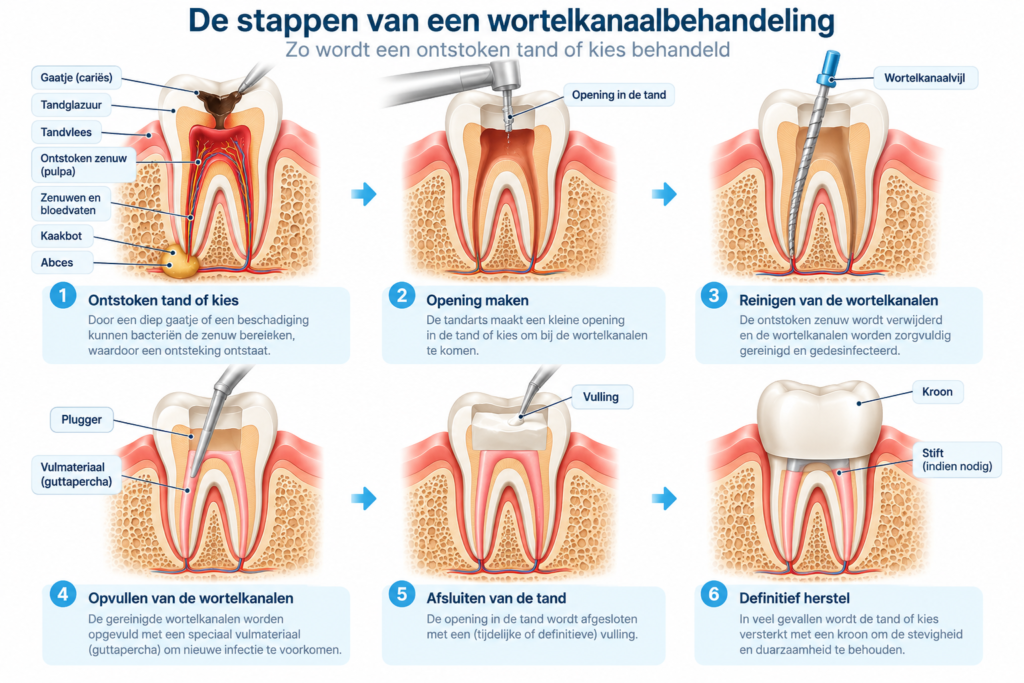
How does a root canal treatment proceed step-by-step?
A root canal treatment consists of several steps. The exact procedure depends on the tooth and the complexity of the root canals.
Examination and X-ray
Beforehand, the dentist examines your teeth and discusses your symptoms.
Using sensitivity tests and an X-ray, it can be determined whether a root canal treatment is necessary.
The roots, the surrounding bone structure, and the possibilities for preserving the tooth are also assessed.
Anesthesia of the tooth
When necessary, the tooth is locally anesthetized.
At We Smile Tandartsen, we use the QuickSleeper, a computer-controlled anesthesia system that allows us to provide targeted and comfortable anesthesia for suitable treatments.
You can find more information about this on our page regarding painless anesthesia.
Opening the tooth
Once the anesthesia is working effectively, the dentist makes a small opening in the tooth.
The root canals are accessed through this opening.
To protect the tooth from saliva and bacteria during the treatment, a rubber dam is typically used.
Cleaning and disinfecting the root canals
Using special instruments, the dentist removes the inflamed or dead tissue.
The root canals are then carefully shaped and rinsed with disinfecting fluids.
At We Smile Tandartsen, we use modern endodontic instruments, including the X-Smart Pro+ system.
Cleaning the canals is a crucial part of the treatment, as bacteria must be removed as much as possible.
Filling the root canals
After cleaning, the root canals are sealed with a special filling material, usually gutta-percha in combination with a root canal sealer.
This is done to prevent bacteria from re-entering the canals.
Sometimes a second appointment is necessary, for example, in the case of complex anatomy or when the treatment cannot be completed in one session.
Restoring the tooth
After the root canal treatment, the tooth is sealed with a final restoration.
Depending on the amount of remaining healthy tooth tissue, this may be a filling, an onlay, or a crown.
Molars with large existing fillings or extensive damage, in particular, sometimes require extra protection to reduce the risk of fracture.
Please also read our article on crowns and bridges for more information on restoring damaged teeth.
Is a root canal treatment painful?
A frequently asked question is whether a root canal treatment is painful.
With effective local anesthesia, the treatment can usually be performed without sharp pain.
You may feel pressure, vibrations, or other movements during the procedure.
In the case of a severely inflamed tooth, it can sometimes be more difficult to achieve full anesthesia. In that case, the dentist can apply additional anesthesia.
What can you expect after the treatment?
After a root canal treatment, the treated tooth may remain sensitive for a few days.
You may experience temporary afterpain, especially when chewing or biting. This is because the tissues around the root tip may still be irritated.
The symptoms usually gradually subside.
If necessary, and if medically suitable for you, you can use a painkiller according to the recommended dosage.
Contact your dentist if the pain clearly increases, if swelling occurs, or if you develop a fever.
How long does a root canal treatment take?
The duration of a root canal treatment depends on several factors.
A front tooth usually has one root canal, while a large molar can have multiple canals.
The shape and accessibility of the canals also play a role.
As a general indication, a treatment can take approximately 45 to 120 minutes. More time may be required for complicated treatments.
Sometimes the treatment is divided over two appointments.
During the examination, the dentist can provide a better estimate of the required treatment time.
What does a root canal treatment cost in Leiden?
The costs of a root canal treatment depend, among other things, on the number of root canals, the complexity, and the required additional examinations.
A front tooth with one canal is generally less extensive to treat than a large molar with three or four canals.
Various cost items may apply to a root canal treatment, such as:
- The dental examination.
- X-rays.
- The root canal treatment itself.
- The use of additional materials and techniques.
- Restoring the tooth with a filling or crown.
In the Netherlands, national maximum rates for dental treatments apply, as established by the Dutch Healthcare Authority (NZa).
At We Smile Tandartsen, we discuss the expected costs in advance, and you will receive a treatment estimate where necessary.
Is a root canal treatment covered by insurance?
For adults aged 18 and over, a root canal treatment is generally not covered by basic insurance.
Do you have supplementary dental insurance? Then you may be able to have part of the costs reimbursed, depending on your policy.
For children up to 18 years old, root canal treatments are in many cases covered by basic insurance.
What happens if you leave an inflamed tooth untreated?
An inflamed dental nerve does not always recover on its own.
When the pulp is irreparably inflamed or has died, bacteria can spread through the root canal to the area around the root tip.
This can lead to various problems:
- Persistent or recurring toothache.
- Inflammation around the root tip.
- A dental abscess.
- Breakdown of bone around the root.
- Eventual loss of the tooth.
Sometimes the pain temporarily disappears because the nerve tissue has died. This does not mean the infection has gone.
A tooth can therefore cause hardly any symptoms for a long time while an inflammation is still present.
When preserving the tooth is possible, a root canal treatment can be a good solution. If the tooth can no longer be restored, extraction may become necessary.
In case of increasing swelling, fever, or severe pain, a prompt assessment is important. In case of swallowing or breathing difficulties, immediate medical help is required.
How long does a tooth last after a root canal treatment?
A tooth can continue to function well for many years after a successful root canal treatment.
The lifespan depends, among other things, on:
- The original damage to the tooth.
- The quality of the root canal treatment.
- The final filling or crown.
- The amount of healthy tooth tissue that is preserved.
- Your oral hygiene and general oral health.
A good seal of the tooth is important to limit new bacterial contamination.
In addition, regular check-ups remain necessary. X-rays can be used if needed to assess whether an inflammation around the root tip is healing.
A root canal treatment offers no absolute guarantee of preservation, but it is an effective way to prevent extraction for many teeth.
Root canal treatment at We Smile Tandartsen in Leiden
Are you suffering from persistent toothache or do you suspect that your dental nerve is inflamed?
At We Smile Tandartsen in Leiden, we carefully investigate the source of your symptoms and discuss which treatment best suits your situation.
Our practice is equipped with modern dental equipment, digital X-ray diagnostics, and computer-controlled anesthesia.
We believe it is important that you understand why a treatment is necessary and what options are available to preserve your own tooth.
If a root canal treatment is particularly complex, we can refer you to a dentist with specific expertise in endodontics if necessary.
Are you looking for a dentist in Leiden? New patients are also welcome at our practice.
Make an appointment for toothache or an inflamed tooth
An inflamed tooth can cause a lot of pain, but that does not automatically mean the tooth must be removed.
With a root canal treatment, the inflammation can be treated in many cases, and your own tooth is preserved.
Do you have persistent toothache, sensitivity when chewing, or swelling around a tooth?
Then have your teeth examined in a timely manner.
At We Smile Tandartsen in Leiden, we are happy to help you with personal advice and a suitable treatment plan.
Make an appointment online at We Smile Tandartsen.
The preservation of your own teeth is our top priority.