


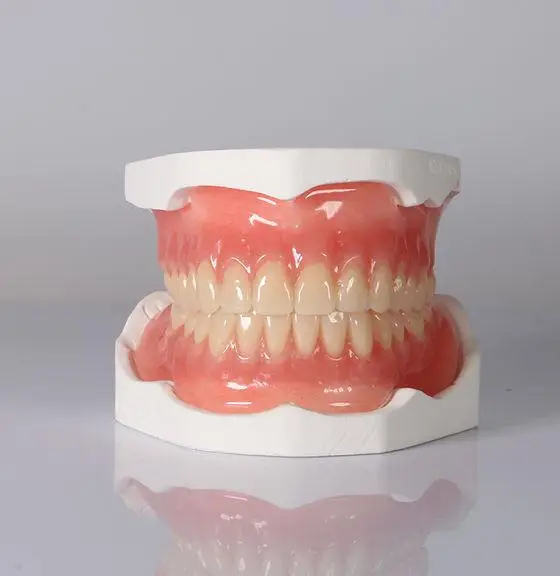
What is a dental prosthesis?
A dental prosthesis is a removable appliance used to replace missing teeth. In common parlance, a full dental prosthesis is often called dentures.
A prosthesis can replace part of the dentition, but also all teeth in the upper or lower jaw. Which version is required depends on the situation in the mouth.
For example, someone who still has a number of healthy teeth may be eligible for a partial prosthesis. When all teeth in a jaw are missing or can no longer be preserved, a full prosthesis may be considered.
Additionally, there are prostheses that receive extra stability through implants in the jaw.
When might a dental prosthesis be necessary?
A dental prosthesis usually only comes into question when several teeth are missing or when a number of dental elements can no longer be preserved.
This can have various causes. Sometimes teeth have been lost due to extensive caries or gum problems. Teeth can also be lost due to an accident or due to problems that have developed over a longer period of time.
The absence of multiple teeth can eventually have consequences for chewing and speaking. The appearance of the teeth can also change.
The decision to remove teeth and replace them with a prosthesis is therefore not taken lightly. First, we look at which teeth can still be preserved and what options are available to restore the dentition.
What types of dental prostheses are there?
Not every dental prosthesis is the same. Broadly speaking, there are several possibilities.
Full dental prosthesis
When all teeth in the upper jaw, lower jaw, or both jaws are missing, a full prosthesis can be made. This replaces the entire natural dentition in that jaw.
Partial dental prosthesis
When enough of your own teeth are still present, sometimes only the missing part can be supplemented. A partial prosthesis is removed from the mouth for cleaning.
Implant-supported dental prosthesis
If a regular prosthesis lacks sufficient stability, implants can provide extra support in certain situations. The prosthesis can then be clicked onto the implants. This is also known as click-on dentures.
Which solution is possible can only be properly assessed after the mouth, the remaining teeth, and the jawbone have been examined.
Do all teeth have to be extracted for a dental prosthesis?
No. A dental prosthesis does not automatically mean that all teeth must be removed.
If certain teeth are healthy and strong enough, we try to preserve them where possible. A partial prosthesis can then supplement the missing teeth.
When teeth are severely affected and can no longer be predictably preserved, removal may be necessary. This will be discussed with you in advance. You will receive an explanation of which teeth can be preserved and what options are available afterwards to supplement the dentition.
What are the benefits of a dental prosthesis?
A well-fitting prosthesis can improve the functioning of the dentition when several teeth are missing. For example, it can help you chew better again and can provide support to the lips and cheeks.
Appearance also plays an important role for many people. Missing front teeth can make someone feel insecure when talking, laughing, or taking photos. A prosthesis can then make a difference not only functionally but also aesthetically.
However, it is important to have realistic expectations. A dental prosthesis feels different from natural teeth, and a period of adjustment is usually required.
How long does it take to get used to a new dental prosthesis?
A new prosthesis may feel strange at first. The mouth must get used to the shape and the way the prosthesis moves during speaking and chewing.
In the initial period, pressure spots may develop, for example. Eating may also feel different, and pronunciation may temporarily change. This often gradually improves as you wear the prosthesis more often.
When a prosthesis causes pain or a pressure spot, it is wise to have it checked. Small adjustments can sometimes make a big difference.
What is the difference between a regular prosthesis and click-on dentures?
A regular full prosthesis rests mainly on the gums and the underlying jaw. Especially in the lower jaw, a prosthesis can sometimes have less stability.
A click-on denture receives support from implants placed in the jawbone. The prosthesis can be clicked onto these, which generally provides more stability.
An implant-supported prosthesis is however not necessary or possible for everyone. This requires looking at, among other things, the quantity and quality of the jawbone and the general situation in the mouth.
How is a dental prosthesis made?
Before a prosthesis is made, the situation in the mouth is first examined and it is discussed which solution may be appropriate.
Several steps are then required to manufacture the prosthesis. Impressions or digital registrations of the mouth are made, and factors such as the bite, position of the teeth, and the shape and color of the new teeth are considered.
During the process, several appointments are usually necessary to check the fit and appearance before the final prosthesis is delivered.
After placement, a check-up or adjustment may be necessary. The mouth changes constantly, and especially after removing teeth, the gums and jawbone can change in the initial period.
How do you care for a dental prosthesis?
Dentures or partial prostheses must also be cleaned daily. Food residues and plaque can also accumulate on a prosthesis.
In addition, oral care remains important. If you still have your own teeth, they must of course be brushed well. But even with a full prosthesis, the gums, tongue, and other mucous membranes deserve attention.
Regular check-ups therefore remain useful, even when you no longer have your own teeth. During these, the fit of the prosthesis and the health of the mouth can be assessed.
When should a dental prosthesis be replaced?
A prosthesis does not last indefinitely. Not only does the prosthesis itself change through use; the mouth also changes over the years. The jawbone can gradually shrink, causing a prosthesis that used to fit well to become increasingly loose.
Do you notice that the prosthesis moves, causes painful spots, is damaged, or that chewing becomes more difficult? Then it is wise to have the fit assessed.
Sometimes an existing prosthesis can be adjusted. In other cases, a new prosthesis is a better solution.
Advice on a dental prosthesis in Leiden
Are you missing several teeth or do you currently have a dental prosthesis that is no longer comfortable? Then it starts with an assessment of your teeth and oral situation.
At We Smile Tandartsen in Leiden we first look at which teeth can be preserved and then discuss which options suit your situation. That could be a dental prosthesis, but depending on the situation, there may also be other possibilities.
This way, you get clarity on the options before you make a choice.