


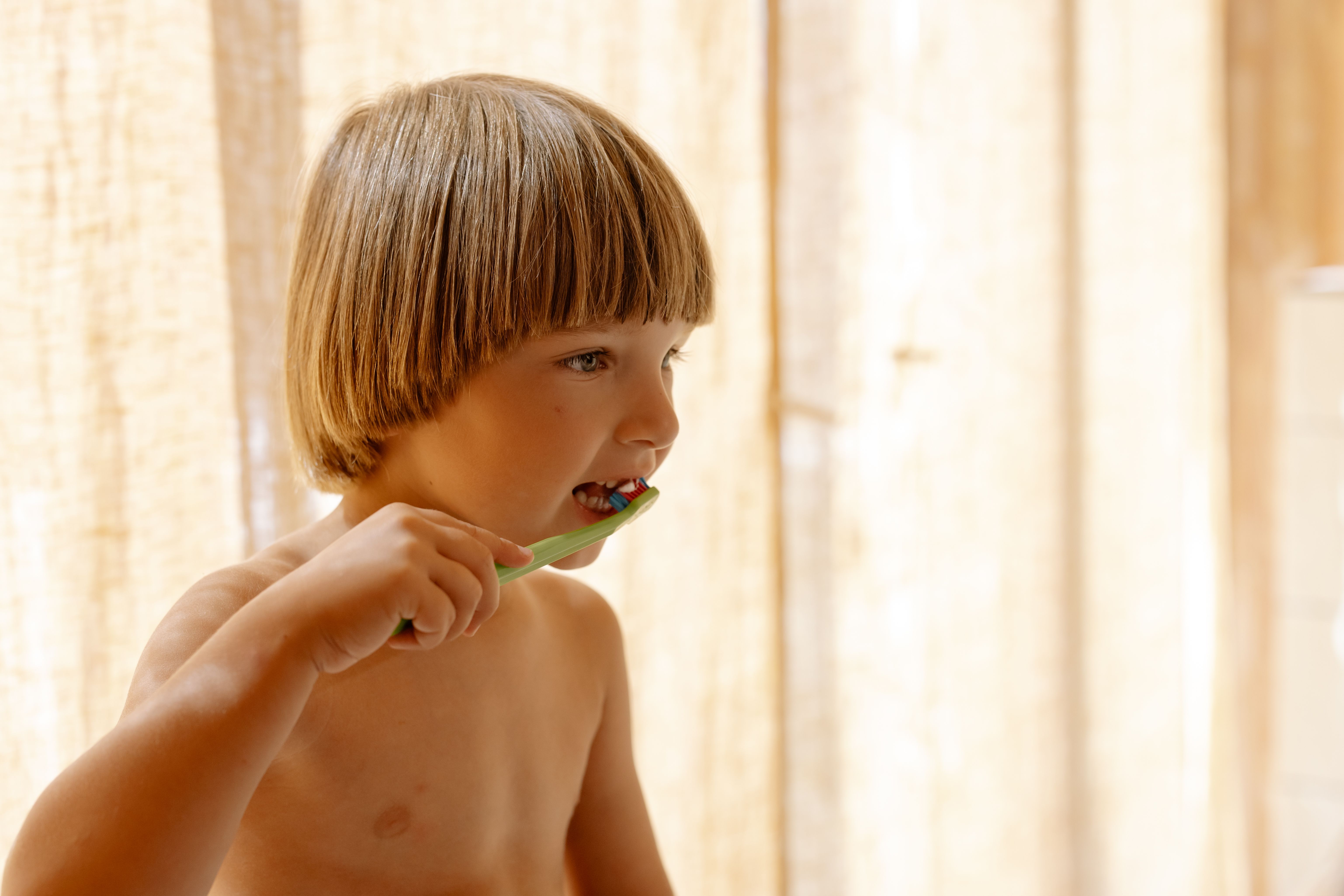
Baby teeth eventually fall out, but that does not mean they are less important. A healthy set of baby teeth helps a child with eating and speaking and plays an important role during the development of the permanent teeth.
Good oral care therefore begins as early as the first tooth.
This often raises questions for parents. When should you start brushing? Which toothpaste should you use? How much toothpaste is needed? When does a child go to the dentist for the first time? And what do you do if your child absolutely refuses to brush?
In this article, we provide practical tips to keep the primary teeth healthy from the very beginning.
Why are baby teeth so important?
A primary dentition consists of twenty teeth and molars. Although these are eventually replaced by permanent teeth and molars, some primary elements remain present for years.
Baby teeth are important for proper biting and chewing and support the development of speech. Additionally, they maintain space for the permanent dentition.
Furthermore, problems with baby teeth can simply cause pain. A deep cavity can lead to toothache or an infection.
The idea that a cavity in a baby tooth is not important because the tooth will be replaced later is therefore incorrect.
When does a baby get their first teeth?
The age at which the first tooth erupts varies per child.
In many babies, the first teeth appear sometime during the first year of life. Usually, the lower front teeth start first, but there is a lot of normal variation.
You do not need to worry immediately if another child of the same age already has more teeth.
As soon as the first tooth is visible, it is time to start brushing.
When should you start brushing baby teeth?
Start brushing as soon as the first tooth has erupted.
Use a small, soft toothbrush suitable for your child’s age and carefully brush all present teeth.
Make tooth brushing part of a fixed daily routine from a young age. For example, at a set time before bedtime.
As more teeth and molars erupt, brushing twice a day becomes increasingly important.
Which toothpaste should you use for a child?
Use a fluoride toothpaste suitable for your child’s age.
Fluoride helps protect tooth enamel against caries and is therefore an important part of daily prevention.
The recommended amount of toothpaste for young children is small and changes with age. Therefore, look at the age advice on the toothpaste and follow the Dutch fluoride recommendations.
Do not simply use extra toothpaste with the idea that more fluoride is automatically better.
If in doubt, the dentist or dental hygienist can show you which amount is appropriate for your child.
How do you brush a young child’s teeth?
Good visibility is important.
For example, let your child sit or lie down with their head supported so that you can look clearly into the mouth. Gently lift the lip and try to systematically brush all teeth and molars.
Do not only brush the front. The inside and chewing surfaces must also be reached.
Pay extra attention to the back molars. The grooves in these molars can be more difficult to keep clean.
It does not have to go perfectly every time. Especially with young children, it is important to make brushing a regular habit.
What if your child does not want to brush their teeth?
Almost every parent has to deal with this.
A toddler may cooperate without problems one day and completely refuse the toothbrush the next. This does not mean you should stop brushing.
Try to keep it predictable and calm. A fixed brushing moment, a song, brushing together, or letting your child try themselves first can help.
Afterwards, you as a parent take over the brushing to ensure that all teeth are actually reached.
Preferably, do not make it a long-term negotiation. Brushing teeth, like washing hands and wearing a seatbelt, is part of daily care.
Until what age should you assist with brushing?
Children often want to brush independently from a young age. This is good to encourage, but young children do not yet have the fine motor skills to clean all surfaces reliably.
Therefore, assistance from a parent remains necessary for a long time.
As a practical guideline, it is often advised to assist with brushing until about 10 years of age. Also consider the individual child. Some children need help for longer.
Feel free to let your child brush themselves first, and then check and brush afterwards.
How do cavities develop in baby teeth?
Caries occurs when bacteria in dental plaque convert sugars from food and drink into acids. When teeth are regularly exposed to this, the enamel can lose minerals and a cavity can eventually develop.
In this process, it is not only important how much sugar a child consumes, but also how often.
Constant sips of a sweet drink, a biscuit, or another snack mean a repeated burden on the teeth.
Therefore, in addition to good brushing, eating and drinking habits are also important.
What is the best thing for your child to drink?
Water is a good choice as a daily thirst quencher.
Try to prevent a child from drinking small amounts of sweet drinks throughout the day. This applies not only to soda. Other sugary drinks can also contribute to the risk of caries.
Especially a bottle or cup with a sweet drink that a child carries around for a long time or falls asleep with is unfavorable for the teeth.
Therefore, make water the standard thirst quencher between meals as much as possible.
Is a bottle of milk before bed bad for the teeth?
Once teeth have erupted, it is important to pay attention to what is consumed after brushing.
After the last brushing session, water is the simplest choice if your child is still thirsty.
Preferably, do not let a child drink from a bottle with a sugary drink for a long period during the night.
Does your baby still have night feedings or do you have questions about nutrition in combination with the first teeth? Feel free to discuss this during the dentist visit. Advice can be tailored to your child’s age and situation.
When should a child go to the dentist for the first time?
Do not wait until your child has a toothache.
It is wise to take a child to the dentist from the eruption of the first tooth.
This allows the dentist to monitor the development of the teeth early on, and parents can receive advice on brushing, fluoride, and eating and drinking habits.
An additional advantage is that your child gets to know the dentist at a time when nothing unpleasant needs to happen.
The first dentist visit can therefore primarily revolve around getting acquainted.
How do you make the first dentist visit pleasant?
Try to present a dentist visit at home as something normal.
You do not need to prepare your child extensively for everything that might happen. Phrases like “it really doesn’t hurt” or “you don’t have to be afraid” can unintentionally give the idea that something scary is going to happen.
Simply say that the dentist is going to count and look at the teeth.
Then let us calmly get to know your child and explain what we are going to do.
With children, we prefer to build contact step by step.
What if your child is afraid of the dentist?
Do not simply force treatment on an anxious child.
Anxiety can have various causes. Sometimes a child has had an unpleasant experience before, while other children are mainly afraid of the unknown.
By getting acquainted calmly and gradually familiarizing a child with the environment, instruments, and treatment, trust can be built.
At We Smile Tandartsen, we find it important to give children the time to get used to the dentist.
What happens if a baby tooth has a cavity?
A cavity in a baby tooth does not always have to be treated in exactly the same way.
The dentist looks at, among other things, the size and location of the cavity, any complaints, the age of the child, and how long the tooth or molar in question is expected to remain present.
Sometimes the emphasis is on prevention and monitoring. In other situations, treatment may be necessary.
In case of pain, swelling, or an infection, the child must always be assessed.
What if a baby tooth breaks or is knocked out?
Children fall regularly while playing, and this can also damage the front teeth.
Has a baby tooth broken, shifted, or come completely out of the mouth? Then contact the dentist for advice.
A completely knocked-out baby tooth is not replaced, as this can cause damage to the permanent tooth developing underneath it.
In the event of dental trauma, it is important to clearly state what happened and when the accident occurred.
Are thumbs and pacifiers bad for the teeth?
Sucking is a natural need for babies and young children.
However, when thumb sucking or pacifier use continues for a long time, it can influence the development and position of teeth and jaws.
The extent of that influence depends, among other things, on how often, how intensively, and for how long the child has the habit.
During check-ups, we can monitor the development of the teeth and, if necessary, discuss when it is wise to phase out thumb sucking or pacifier use.
When do the first permanent teeth arrive?
Around school age, the primary teeth gradually begin to be replaced.
An important moment is the eruption of the first permanent molars. These appear behind the last baby molars and therefore do not replace a baby tooth.
As a result, parents sometimes do not notice that these are already permanent molars.
It is precisely these new molars that deserve extra attention during brushing. During eruption, they are sometimes lower than the other molars and can therefore be more difficult to reach.
Are dental check-ups for children free?
For children up to 18 years old, much of the regular dental care in the Netherlands is covered by basic insurance. There are exceptions; for example, orthodontics is not standardly covered under regular dental reimbursement from basic insurance.
Therefore, if in doubt, you can always check with your health insurer beforehand whether a specific treatment is covered.
Do not let costs automatically be a reason not to take a young child to the dentist.
Pediatric dentist in Leiden: starting oral care young
At We Smile Tandartsen in Leiden, we find it important that children get to know the dentist in a relaxed way from a young age.
We monitor the development of the teeth and provide parents with practical advice on brushing, fluoride, nutrition, and preventing cavities.
By bringing children along from the first tooth, a dentist visit can become part of normal care instead of something that only happens when there is pain.
Has your child gotten their first teeth? Feel free to bring your child for an initial introduction and check-up.