


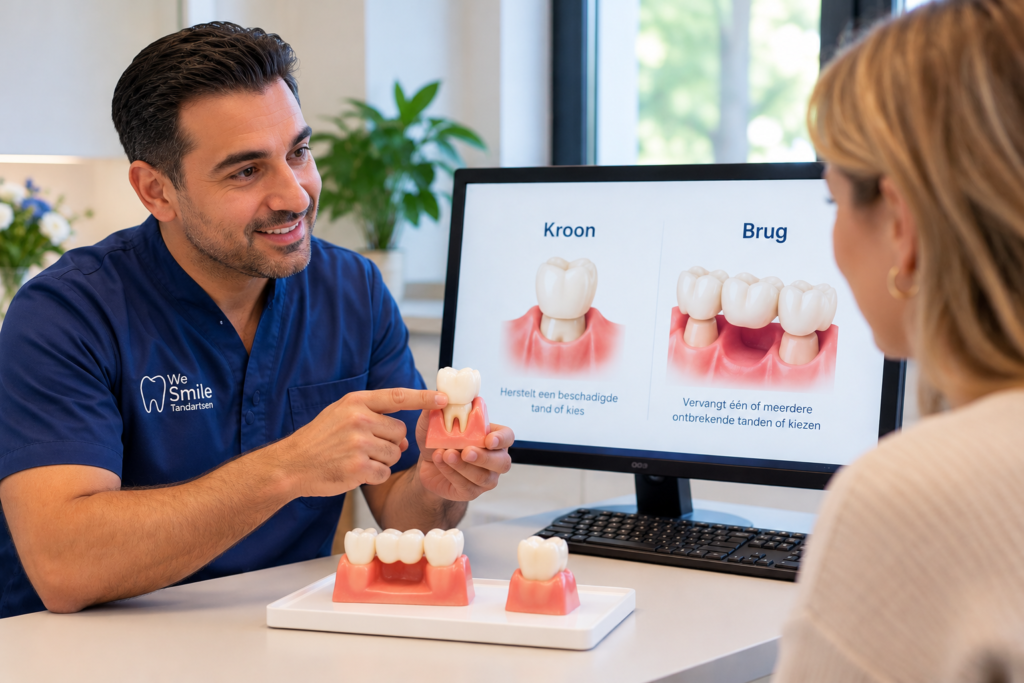
A crown and a bridge are both used to restore the teeth, but they have a different function. A crown usually restores an existing tooth, while a bridge can replace one or more missing teeth.
Are you unsure whether a crown or bridge is needed in your situation? The choice depends, among other things, on how much healthy tooth tissue is still present, the condition of the adjacent teeth, the location of the missing tooth, and your preferences.
In this article, we explain the difference between a crown and a bridge, how both treatments proceed, and what alternatives are available.
What is a crown?
A crown is a cap that is placed over an existing tooth.
The tooth remains present but is prepared so that the crown can be placed over it. The crown restores the shape and function of the tooth and can be matched in color and shape to the rest of the teeth.
A crown may be considered, for example, when a tooth is so severely damaged or weakened that a regular filling provides insufficient support or protection.
When might a crown be necessary?
Not every damaged tooth automatically requires a crown.
For smaller damages, a composite restoration may be sufficient. As less healthy tooth tissue remains, a more extensive restoration may be necessary.
A crown may be considered for a severely weakened or broken tooth, a very large existing restoration, or in certain situations after root canal treatment.
A crown can also be part of an implant treatment: the crown then forms the visible part of the new tooth and is attached to the implant.
We assess which solution is suitable for each individual tooth.
Is a crown always necessary after root canal treatment?
No, not automatically.
After root canal treatment, we look at how much healthy tooth tissue is still present, which tooth is involved, and how much load it receives during chewing.
Molars, in particular, can be more susceptible to fracture after extensive loss of tooth tissue. In such a situation, a crown or other restoration that protects the cusps may be advised.
For a tooth that still has sufficient strong tooth tissue, another restoration may sometimes be suitable.
A root canal treatment does not, therefore, by definition mean that a crown must always be placed afterward.
What is a bridge?
A dental bridge is used to bridge a gap where one or more teeth are missing.
In a traditional bridge, the teeth on either side of the empty space are used as abutments.
Crowns are placed on these abutments. Between them is one or more artificial teeth that replace the missing teeth. The components together form one fixed construction.
A bridge is fixed in the mouth and is therefore not removed daily like a removable dental prosthesis.
When can a bridge be a good solution?
A bridge may be considered when a tooth is missing and you want to restore the open space.
Among other things, the teeth next to the space are examined. These must be suitable to support the bridge.
When adjacent teeth already have large restorations or crowns, a traditional bridge may be logical in certain situations.
If the adjacent teeth are completely intact, it is important to also discuss alternatives. For a traditional bridge, the abutments must be prepared to support the crowns.
What is the main difference between a crown and a bridge?
The main difference is the function.
A crown restores an existing tooth. A bridge replaces a missing tooth by bridging the empty space.
A crown is usually placed on one existing tooth. A traditional bridge consists of several interconnected parts and rests on adjacent teeth.
There are also implant-supported crowns and bridges. In these cases, the construction is not supported exclusively by natural teeth, but by one or more implants.
Do teeth need to be ground down for a crown?
For a conventional crown, the existing tooth must be prepared.
Tooth tissue is removed to create sufficient space for the crown and to ensure it can be placed correctly.
How much preparation is needed depends, among other things, on the condition of the tooth and the material and design of the restoration.
Therefore, a crown is not placed lightly if a tooth can be sustainably restored in a less invasive way.
Do healthy teeth need to be ground down for a bridge?
With a traditional tooth-supported bridge, the abutments must be prepared for the crowns of the bridge.
This is an important point of consideration when the teeth next to the missing tooth are still completely healthy and intact.
In such a situation, an implant may be interesting, for example, because the adjacent teeth usually do not need to be prepared as abutments.
There are also other types of bridges, such as an adhesive bridge, where the attachment works differently and sometimes less tooth tissue needs to be removed.
Which option is suitable depends heavily on the location and the individual situation.
What is the difference between a bridge and an implant?
Both a bridge and an implant can be used to replace a missing tooth, but the way they do so differs.
A traditional bridge uses the adjacent teeth as support. With an implant, an artificial root is placed in the jawbone. A crown can then be attached to this.
An advantage of an implant is that adjacent teeth usually do not need to be prepared as abutments.
On the other hand, placing an implant is a surgical treatment and requires sufficient healthy bone and gum tissue. An implant process also usually takes longer because the implant must first heal and integrate into the jawbone.
Therefore, there is no single solution that is better for everyone.
How is a crown made?
Before a crown is made, the tooth is examined and it is assessed whether a crown is a suitable restoration.
The tooth is then prepared for the crown.
Afterward, the shape of the tooth and the surrounding teeth must be accurately recorded. Depending on the situation, this can be done with a digital oral scan or a conventional impression.
Based on this, the final crown is manufactured.
When the crown is ready, it is checked whether it fits well, whether the contact with the other teeth is correct, and whether the bite feels right. The crown can then be permanently attached.
How is a bridge made?
Making a traditional bridge proceeds partly the same as making a crown.
First, the teeth serving as abutments are prepared. Then, the situation is accurately recorded with a scan or impression.
Based on this, the bridge is manufactured.
During placement, the fit, bite, shape, and connection to the abutments are checked.
Because a bridge connects several teeth, the ability to keep the construction clean is also important.
Does placing a crown or bridge hurt?
Preparing teeth for a crown or bridge is normally done under local anesthesia when necessary.
As a result, the treatment itself should be well-tolerated.
After the treatment, a tooth or the surrounding gum may be temporarily sensitive. A new crown or bridge may also feel different during chewing at first.
Do you have persistent pain after placement or does the bite feel clearly too high? Please contact the dentist so this can be checked.
How do you care for a crown?
A crown itself cannot get a cavity, but the natural tooth underneath and along the crown margin can.
Therefore, good oral care remains important.
Brush carefully twice a day with fluoride toothpaste and pay attention to the transition between the crown and the gum.
The spaces between the teeth must also be kept clean with tools that suit your teeth.
How do you clean a bridge?
A bridge requires a bit more attention because the artificial tooth cannot be cleaned with floss in the same way as a separate natural tooth.
Especially the area under the artificial tooth and around the abutments must be kept clean.
Depending on the space, interdental brushes or special floss can be used, for example.
The dentist or dental hygienist can show you which method is most suitable for your bridge.
Good cleaning is important to keep the gums healthy and to protect the natural abutments as well as possible.
Can a cavity develop under a crown or bridge?
Yes.
Although the material of a crown or bridge itself does not get caries, the underlying and adjacent natural teeth remain susceptible to tooth decay.
Especially along the transition between the crown and the natural tooth, a problem can arise if plaque remains there for a long time.
Therefore, daily oral care and periodic check-ups remain important, even when a crown or bridge has been functioning without problems for years.
How long does a crown or bridge last?
There is no fixed lifespan that applies to every crown or bridge.
A well-made and well-maintained restoration can function for many years, but eventually, wear, caries, gum problems, fracture, or changes to the underlying teeth can occur.
Grinding and clenching can also place extra load on them.
Therefore, I would remove the current statement “10 to 15 years or longer” from the blog. It is more useful for patients to explain which factors influence the lifespan than to mention a number that is easily read as a guarantee.
What happens if a crown or bridge comes loose?
Contact the dentist if a crown or bridge comes loose.
Do not attempt to reattach the restoration yourself with superglue or other household adhesives.
Keep a loosened crown or bridge and bring it with you to your appointment.
Sometimes a restoration can be reattached. In other situations, there may be caries, damage to the underlying tooth, or a fracture requiring a different treatment.
Therefore, it must first be investigated why the crown or bridge came loose.
What is cheaper: a crown, bridge, or implant?
Costs cannot be properly compared without looking at the full treatment.
A single crown, a multi-unit bridge, and an implant with a crown consist of different treatment steps and therefore have different costs.
With an implant, for example, surgical treatment and additional diagnostics may be necessary. With a bridge, the number of abutments and elements plays a role.
Therefore, a personal estimate is much more useful than just looking at one standard price.
After examination, the various treatment options and expected costs can be discussed with you.
Crown, bridge, or implant: what fits your situation?
That depends mainly on what needs to be restored.
Is the natural tooth still present but severely damaged? Then a crown or another restoration may be considered.
Is a tooth completely missing? Then a bridge or implant may be a possibility, for example.
In doing so, we look at the condition of the surrounding teeth, the amount of healthy tooth tissue, gums, jawbone, bite, and your personal preferences.
Sometimes a solution other than a crown, bridge, or implant is even more suitable.
Therefore, the choice always begins with an examination of your teeth.
Advice on a crown or bridge in Leiden
Do you have a damaged tooth or is a tooth missing?
At We Smile Tandartsen in Leiden, we can examine your teeth and discuss the possibilities for restoring the tooth or replacing the missing space.
When a crown or bridge is suitable, we can accurately record your teeth with a digital oral scan to manufacture the restoration.
If an implant might be a better option, we can discuss the possibilities with you and refer you for implantological treatment.
Would you like to know which solution suits your teeth? Then make an appointment for personal advice.