


Healthy gums form an important foundation for the preservation of your teeth and molars. Yet, gums often only receive attention when they start to bleed, become sensitive, or recede.
Healthy gums are generally calm in color, fit firmly around the teeth, and do not bleed regularly during brushing or cleaning between the teeth.
Bleeding gums are often an initial sign of inflammation. When gum inflammation persists for a longer period and the supporting tissue around the teeth is also affected in susceptible individuals, periodontitis can develop.
Fortunately, there is much you can do yourself to keep your gums healthy. Below you will find seven practical tips.
1. Brush carefully along the gum line twice a day
Good daily oral care begins with carefully brushing your teeth twice a day with fluoride toothpaste.
Pay extra attention to the transition between teeth and gums. Plaque can accumulate specifically along this gum line.
An electric toothbrush can help with systematic brushing, but you can also clean your teeth well with a manual toothbrush if you use the correct technique.
Brushing hard is not necessary. Too much pressure does not make your teeth cleaner and can contribute to damage to the gums or tooth surface in the long term.
2. Also clean between your teeth and molars
A toothbrush alone does not reach all surfaces of the teeth.
Plaque can remain between teeth and molars. When this plaque is not sufficiently removed, the gums there can become inflamed.
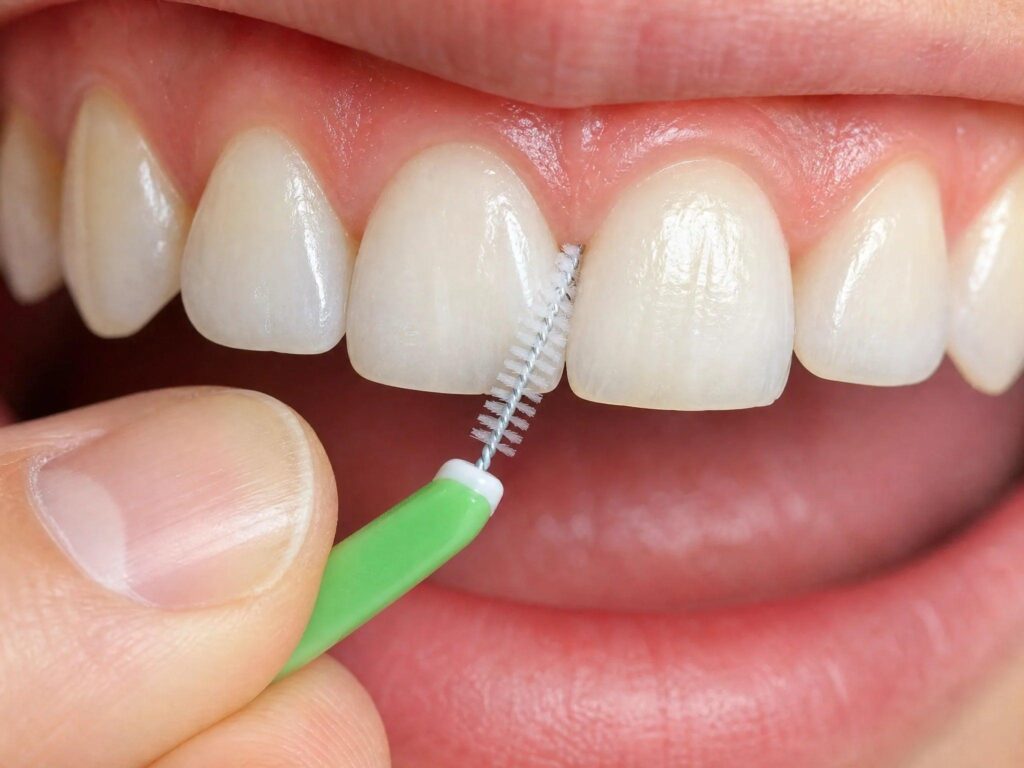
For many adults, interdental brushes are a practical tool for cleaning the spaces between teeth and molars. The appropriate size varies per space.
For very narrow spaces, another tool may be more suitable.
Your dentist or dental hygienist can show you which method and size fit your teeth.
3. Do not stop brushing if your gums bleed
When gums bleed during brushing, people are sometimes inclined to avoid that specific area.
This is usually not wise.
Bleeding gums are often caused by an inflammatory response to plaque. When you stop cleaning the area, the plaque remains and the inflammation can persist.
Therefore, continue to brush gently but thoroughly and pay extra attention to the gum line and the spaces between the teeth.
Do the gums continue to bleed regularly despite good oral care? Then have them checked.
4. Have tartar removed when necessary
Plaque is a soft layer that you can remove yourself at home.
When plaque mineralizes and hardens, tartar (calculus) is formed. You can no longer remove tartar with a regular toothbrush.
The rough surface also makes it easier for new plaque to accumulate around the area.
When tartar is present, it can be professionally removed by the dentist or dental hygienist.
How often professional cleaning is required varies per person. Therefore, not everyone automatically needs to have tartar removed according to the same schedule.
5. Pay attention to the first signs of gum problems
Gum problems do not always cause pain.
Therefore, pay attention to other changes as well.
Bleeding gums during brushing or cleaning between the teeth can, for example, indicate inflammation. Redness, swelling, receding gums, or a change in the position or mobility of teeth can also be reasons to have your teeth assessed.
A bad taste or persistent bad breath can also be associated with problems in the mouth, although other causes for this also exist.
Do not automatically wait until pain occurs when changes are noticed.
6. Do not smoke
Smoking is a major risk factor for periodontitis and can adversely affect gum health.
A particular problem is that the gums of smokers sometimes bleed less obviously, even though inflammation may still be present.
As a result, warning signs may be less noticeable.
Quitting smoking is therefore not only beneficial for general health but also for the health and prognosis of the gums.
7. Have your gums checked regularly
Even when you are not in pain, gum problems may be present.
During a check-up, the dentist or dental hygienist can assess whether the gums are healthy and if there are signs of inflammation.
When indicated, the space between the tooth and the gum can be measured. It can also be assessed whether tartar is present and if additional research is necessary.
How often a check-up or professional cleaning is advisable depends on your personal situation.
Someone with healthy and stable gums does not automatically require the same interval as someone who has previously had periodontitis.
What do healthy gums look like?
Healthy gums generally fit firmly around the teeth and molars and do not bleed regularly with normal oral care.
The exact color varies from person to person. Healthy gums do not have to be light pink for everyone.
More important are changes compared to your normal situation.
When the gums suddenly become redder or swollen, bleed regularly, or clearly recede, it may be wise to have this assessed.
Why do gums bleed during brushing?
The most common cause of regularly bleeding gums is inflammation due to plaque.
When plaque remains along the gum line for a longer period, the gums respond with an inflammatory reaction. This can cause the tissue to bleed more easily.
This is called gingivitis.
Gingivitis can recover with good plaque control. When the inflammation spreads to the deeper supporting tissues around the teeth and molars in susceptible individuals, we refer to it as periodontitis.
Therefore, regularly bleeding gums is a signal to be taken seriously.
What is the difference between gingivitis and periodontitis?
With gingivitis, the inflammation is limited to the gums.
The gums may be red or swollen and bleed more easily, but there is not yet any loss of the supporting tissue around the teeth due to periodontitis.
With periodontitis, the deeper supporting tissues are also affected. This can lead to the loss of jawbone around the teeth and molars.
This process does not always cause clear pain.
In an advanced stage, teeth may eventually become loose.
Therefore, it is important to recognize gum problems in time and treat them where necessary.
Is receding gums the same as periodontitis?
No.
Receding gums can have various causes and do not automatically mean that you have periodontitis.
It can, for example, be related to the position of a tooth, thin gums, or mechanical stress.
Periodontitis can also be accompanied by receding gums, but in that case, there is a loss of supporting tissue around the teeth.
The dentist or dental hygienist can investigate the likely cause of the receding gums.
What influence does nutrition have on healthy gums?
A varied diet is important for general health and thus for normal bodily functions and tissues.
However, for the prevention of gum inflammation, nutrition alone is not the most important measure.
The daily removal of plaque along and between the teeth remains essential.
For your teeth as a whole, it is also wise to limit the number of eating and drinking moments containing sugar. This is especially important for reducing the risk of caries.
I would therefore not leave the current sentence stating that “limiting sugar reduces bacterial growth” as it is. For gum health, that is too simplistic.
Do healthy gums influence the preservation of teeth?
Yes. Teeth are not only set in the jawbone but are supported by various tissues around the tooth.
When periodontitis remains active for a long time, part of this supporting tissue can be lost.
In cases of severe supporting tissue loss, teeth can eventually become mobile and, in some situations, be lost.
A healthy set of teeth is therefore not just about teeth without cavities. Healthy gums and healthy supporting tissue are equally important for the long-term preservation of teeth and molars.
When should you see a dentist or dental hygienist for gum problems?
Have your gums assessed if they continue to bleed regularly, are clearly swollen, or seem to be receding further and further.
Pus around the gums, loosening teeth, or changes in the position of teeth are also reasons to make an appointment.
Have you had periodontitis before? Then aftercare remains extra important, even if you are not currently experiencing any symptoms.
Do not wait until pain occurs when such changes happen.
Healthy gums at We Smile Tandartsen in Leiden
Are you suffering from bleeding or receding gums, or do you want to know if your gums are healthy?
At We Smile Tandartsen in Leiden, we can assess your gums and discuss which oral care fits your situation.
When professional cleaning or additional gum treatment is necessary, our dental hygienist can guide you through the process.
We also provide practical advice on brushing and cleaning between teeth and molars, so that you can take the best possible care of your gums at home.
Would you like to have your gums checked? Then make an appointment for a check-up or with our dental hygienist.