


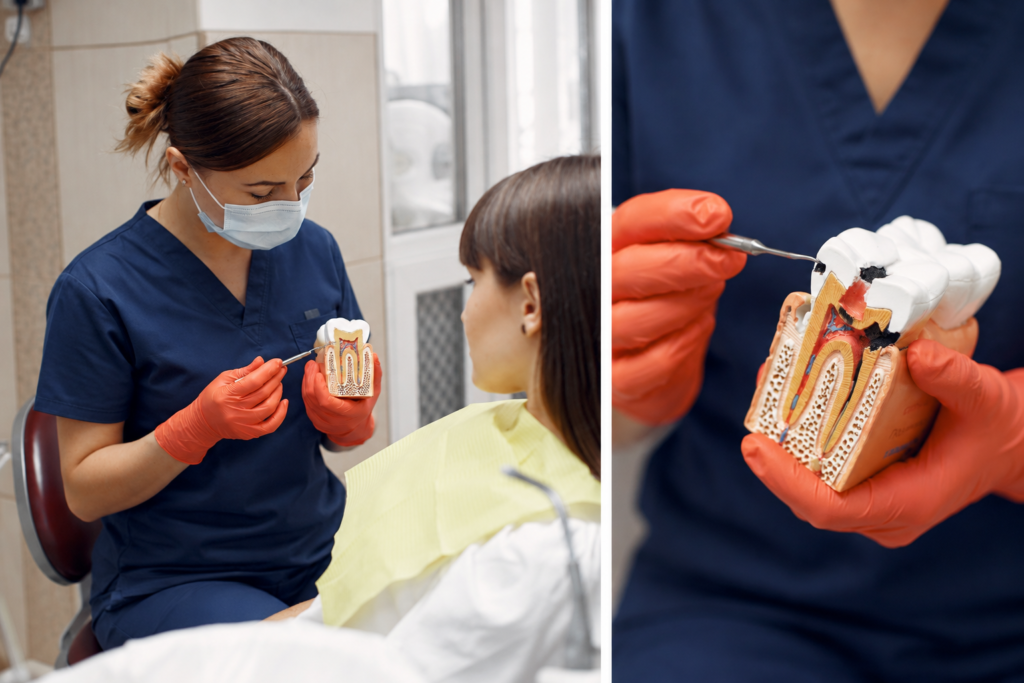
How does a root canal treatment work step by step?
For many people, a root canal treatment sounds more daunting than it actually needs to be. Often, the treatment is performed precisely because a tooth or molar is inflamed and causing pain. The goal is to remove the inflamed or infected tissue from the tooth, clean the root canals thoroughly, and preserve the tooth if possible.
But what exactly happens during such a treatment? How is a root canal located, does the treatment hurt, and why do you sometimes need to return multiple times?
Below, we explain step by step what you can expect.
Why is a root canal treatment necessary?
Inside a tooth or molar lies the pulp. This is soft tissue containing nerves and blood vessels. When this tissue becomes inflamed or infected, a root canal treatment may be necessary.
Such inflammation can arise, for example, from a deep cavity, a leaking or deep filling, a crack or fracture in the tooth, or due to previous trauma.
Sometimes an inflamed dental nerve causes severe toothache. The tooth may, for instance, react strongly to heat or cold or hurt when biting. However, inflammation can also be present without you experiencing many symptoms at that moment. Therefore, the diagnosis is not based solely on pain.
The dentist assesses your symptoms, examines the tooth or molar, and takes an X-ray if necessary.
What happens during a root canal treatment?
A root canal treatment consists of several steps. The exact treatment varies per tooth or molar. For example, a front tooth usually has a simpler root canal system than a large molar with multiple roots and canals.
Below we explain the treatment process.
Step 1: examination and anesthesia
Before the treatment, it is first determined which tooth or molar is causing the symptoms and what the condition of the element is.
The area is then anesthetized. We check whether the anesthesia is sufficiently effective before we begin the treatment.
At We Smile Tandartsen, we also have the QuickSleeper, which allows us to administer anesthesia comfortably for many treatments.
The goal is for you to experience as little discomfort as possible during the treatment.
Step 2: opening the tooth or molar
Once the anesthesia is working well, the dentist makes a small opening in the tooth or molar. The root canals become accessible through this opening.
The inflamed, infected, or dead tissue that must be removed is located in the canals.
The number of root canals varies per tooth or molar. Molars in particular can have multiple canals, and their shape can vary per person.
Step 3: locating the root canals and determining length
To treat a root canal properly, it must be known how far the canal extends.
The dentist therefore determines the working length of the root canals. Electronic length determination and X-rays can be used for this purpose.
This is important because the canal must be cleaned over the correct length and later also carefully filled.
Step 4: cleaning and disinfecting
Subsequently, the root canals are cleaned with fine instruments and gradually shaped.
During this process, the canals are also rinsed with a disinfecting liquid. With this, we attempt to remove bacteria, tissue remains, and other material from the root canal system as thoroughly as possible.
This is a crucial part of the treatment. A root canal is very small and can contain branches and irregularities that are not visible to the naked eye.
Step 5: filling the root canals
When the canals have been sufficiently cleaned and the situation permits, they are sealed with special filling material.
The goal of this is to seal the cleaned space as effectively as possible, so that bacteria cannot easily re-enter the root canal.
Not every root canal treatment can be completed in a single appointment. Sometimes the treatment is divided over multiple appointments, and the tooth or molar receives a temporary seal in the interim.
Step 6: restoring the tooth or molar
After the root canal treatment, the visible part of the tooth or molar must also be properly sealed again.
Depending on how much healthy tooth tissue is still present, this can be done with a filling, for example. For a tooth or molar that is severely weakened, a more extensive restoration may be required later.
Which restoration is suitable depends on the amount of remaining tooth tissue, the position of the tooth or molar, and the load during chewing.
Does a root canal treatment hurt?
This is probably the question we hear most often.
A root canal treatment is performed under local anesthesia. The starting point is therefore that the treatment itself can be carried out comfortably.
A severely inflamed tooth can sometimes be more difficult to anesthetize. In that case, additional anesthesia may be required. Always indicate during the treatment if you still feel something.
Afterwards, the tooth or molar may remain sensitive for some time. The area may feel somewhat bruised, especially when biting or chewing. This does not automatically mean that the treatment did not go well.
In case of severe or increasing pain, significant swelling, fever, or if you are concerned, it is advisable to contact the dentist.
How long does a root canal treatment take?
That varies considerably.
A front tooth with one relatively simple canal can generally be treated faster than a large molar with multiple roots and complex root canals.
The severity of the inflammation and any previous treatments also play a role.
Therefore, it is not possible to state exactly the same treatment time for every root canal treatment in advance. Sometimes the treatment can be completed during one appointment, and sometimes multiple appointments are necessary.
Why are multiple appointments sometimes necessary?
Ideally, a treatment is performed efficiently, but it is more important that the root canals can be treated with care.
For example, in the case of an extensive infection, complex anatomy, or when the treatment requires more time than expected, it may be decided to continue the treatment during a subsequent appointment.
The tooth or molar is then sealed in the interim. The treatment can be further carried out during the follow-up appointment.
How does a tooth feel after a root canal treatment?
Because the tissue has been removed from the root canal, the tooth can no longer react to cold or heat in the same way as a vital tooth.
However, that does not mean you will never feel anything around the tooth again. The tissues surrounding the root remain present. Consequently, you may still feel pressure when you bite on the tooth, for example.
Shortly after the treatment, this area may be temporarily sensitive.
Can a root canal treatment always save a tooth?
The goal of a root canal treatment is to preserve a tooth or molar that might otherwise be lost. Unfortunately, not every tooth can be saved.
A severe fracture, insufficient healthy tooth tissue, certain root problems, or a very unfavorable prognosis can be reasons why a root canal treatment is not the best solution.
Therefore, before the treatment, we look not only at the inflammation but also at whether it is meaningful and feasible to restore the tooth sustainably afterwards.
What if a root canal treatment is complicated?
Not every root canal system is the same. Some teeth and molars have strongly curved, very narrow, or difficult-to-reach canals. A tooth that has previously had a root canal treatment can also be extra complex.
When a treatment requires specialist knowledge or equipment, a referral to an endodontist can be discussed.
Ultimately, the most important thing is not where the treatment is performed, but that a treatment is chosen that suits the complexity and prognosis of the tooth.
Root canal treatment at We Smile Tandartsen in Leiden
Do you have persistent toothache or do you suspect a tooth is inflamed? Then it is important to first determine where the symptoms are coming from. Toothache does not automatically mean that a root canal treatment is necessary.
At We Smile Tandartsen in Leiden, we examine the tooth or molar and discuss our findings with you. When a root canal treatment is necessary, we explain in advance what the treatment involves and what the options are.
When a root canal treatment is too complex to be performed responsibly within general practice, a referral to an endodontist can be discussed.
Do you have a toothache or would you like to have a tooth or molar assessed? Please contact us for an appointment.
{ “@context”: “https://schema.org”, “@type”: “FAQPage”, “mainEntity”: [ { “@type”: “Question”, “name”: “Wanneer is een wortelkanaalbehandeling nodig?”, “acceptedAnswer”: “@type”: “Answer”, “text”: “Een wortelkanaalbehandeling is nodig wanneer de tandzenuw ontstoken of geïnfecteerd is, bijvoorbeeld door een diep gaatje, een lekkende vulling of een breuk in de tand.” }, { “@type”: “Question”, “name”: “Doet een wortelkanaalbehandeling pijn?”, “acceptedAnswer”: “@type”: “Answer”, “text”: “Dankzij moderne verdoving is de behandeling meestal niet pijnlijk. Na afloop kan er enkele dagen lichte gevoeligheid of napijn optreden.” }, { “@type”: “Question”, “name”: “Hoe lang duurt een wortelkanaalbehandeling?”, “acceptedAnswer”: “@type”: “Answer”, “text”: “De behandeling duurt meestal één afspraak van ongeveer 60 tot 90 minuten. Soms zijn meerdere afspraken nodig, afhankelijk van de situatie.” }, { “@type”: “Question”, “name”: “Is een kroon nodig na een wortelkanaalbehandeling?”, “acceptedAnswer”: “@type”: “Answer”, “text”: “Vaak wordt een kroon aanbevolen om de verzwakte tand extra te beschermen en breuk te voorkomen, vooral bij kiezen die veel kauwkracht opvangen.” }, { “@type”: “Question”, “name”: “Hoe lang gaat een tand mee na een wortelkanaalbehandeling?”, “acceptedAnswer”: “@type”: “Answer”, “text”: “Met goede mondhygiëne en regelmatige controle kan een behandelde tand nog vele jaren, en soms levenslang, meegaan.” } ] }