


Painless anesthesia at the dentist: how does the QuickSleeper work?
Are you afraid of the anesthetic injection at the dentist? Or have you ever experienced a painful anesthesia? For many people, it is not the dental treatment itself, but rather the anesthesia that is a stressful moment.
Fortunately, there are modern techniques available today that often allow dental anesthesia to be administered much more comfortably.
At We Smile Tandartsen in Leiden, we utilize the QuickSleeper, a computer-controlled anesthesia system that helps to administer the anesthetic fluid in a controlled and precise manner.
This technique can be particularly pleasant for patients who dread a traditional injection.
But how exactly does the QuickSleeper work? Is the anesthesia truly painless? And what are the advantages compared to a standard anesthetic injection?
In this article, we explain what you can expect.
Why can dental anesthesia be painful?
Many dental treatments require local anesthesia. Examples include filling a deep cavity, performing a root canal treatment, or extracting a tooth.
With traditional anesthesia, anesthetic fluid is administered into the tissue using a hypodermic needle.
The discomfort patients experience is not only caused by the prick itself. The pressure with which the fluid is introduced into the tissue can also cause an unpleasant or burning sensation.
Additionally, sensitivity varies by location in the mouth. Some areas are more sensitive than others.
For patients who have previously had a painful anesthesia, this can cause tension during their next dental appointment.
A modern anesthesia technique can help to reduce this discomfort.
What is the QuickSleeper?
The QuickSleeper is a computer-controlled system for administering local anesthesia in dentistry.
Unlike a traditional manual syringe, the administration of the anesthetic fluid is electronically controlled.
This allows the fluid to be delivered at a controlled speed.
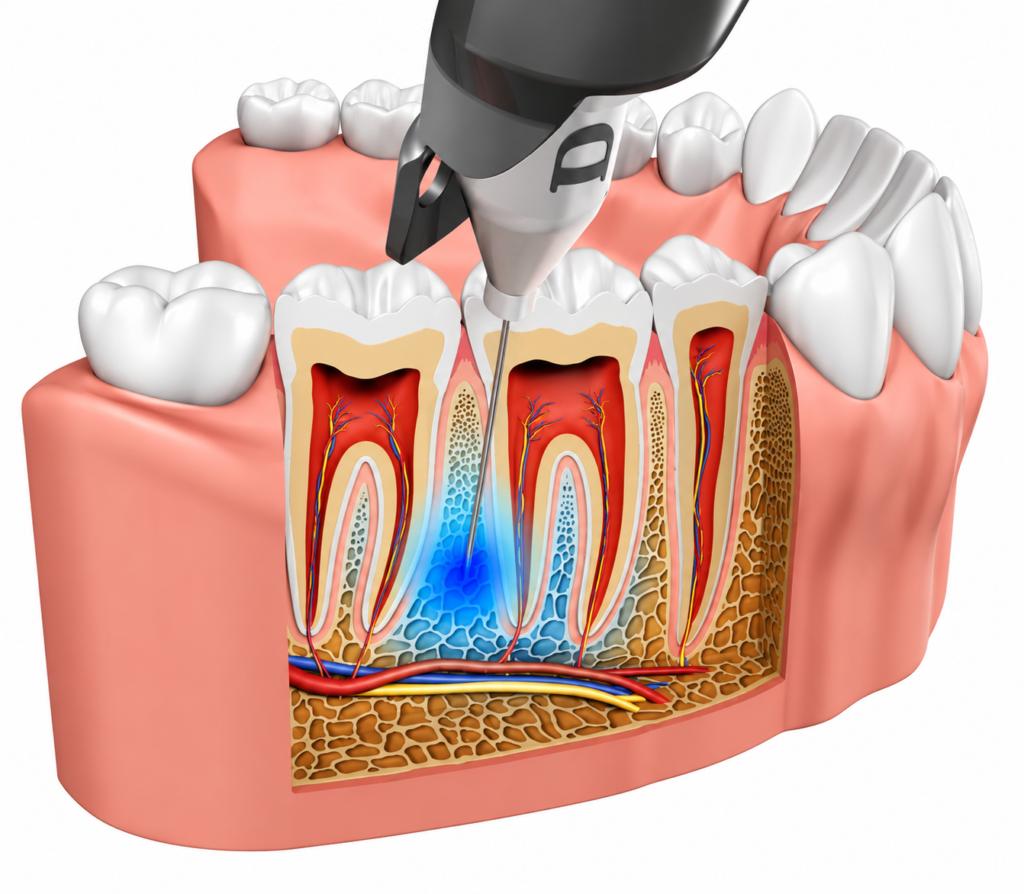
The QuickSleeper also enables various anesthesia techniques, including intraosseous anesthesia. In this method, the anesthetic fluid is administered into the spongy bone surrounding the tooth roots.
This makes it possible to anesthetize specific teeth and molars in a targeted manner.
The main advantage is that the anesthesia can be administered accurately and often comfortably.
The QuickSleeper still uses a needle. It is therefore not a needle-free anesthesia, and completely painless anesthesia cannot be guaranteed for every patient.
How does anesthesia with the QuickSleeper work?
At We Smile Tandartsen, we assess in advance which anesthesia technique is most suitable for your treatment.
When the QuickSleeper is used, the anesthesia process generally follows a number of steps.
Determining the correct anesthesia site
The dentist determines which tooth or molar needs treatment and which anesthesia technique is appropriate.
Not every treatment requires the same form of anesthesia.
Administering the anesthesia in a controlled manner
Using the computer-controlled system, the anesthetic fluid is administered at a precisely controlled speed.
This limits the pressure on the surrounding tissue.
This can make the administration of the anesthesia more comfortable.
Targeted anesthesia around the tooth
With intraosseous anesthesia, the anesthetic fluid is administered via a small perforation in the jawbone.
This allows the anesthesia to become effective relatively quickly around the tooth or molar being treated.
Checking if the anesthesia is working properly
Before the dental treatment begins, we check whether the treated area is sufficiently anesthetized.
If the anesthesia is not working sufficiently, additional anesthesia may be required.
Our starting point is that you can undergo the treatment as comfortably as possible.
Is anesthesia with the QuickSleeper truly painless?
The term painless anesthesia is often used to describe modern anesthesia techniques.
However, it is important to distinguish between a comfortable anesthesia and one that is guaranteed to be completely painless.
Many patients find computer-controlled anesthesia pleasant because the fluid is administered in a controlled manner.
With the QuickSleeper, the dentist can also use techniques where the anesthesia is applied specifically around the tooth.
However, the experience varies per person. The sensitivity of the tissue, the chosen technique, and the level of tension all play a role.
At We Smile Tandartsen, we strive for the most comfortable anesthesia possible, but we do not promise that you will feel absolutely nothing.
We take our time, explain what we are doing, and take your reaction into account during the treatment.
What are the advantages of the QuickSleeper?
The QuickSleeper has several features that can offer advantages for certain dental treatments.
Controlled administration of anesthetic fluid
The computer-controlled system regulates the administration of the fluid. This allows the anesthesia to be delivered accurately and with limited pressure.
Targeted anesthesia
With intraosseous anesthesia, the anesthetic can be administered relatively locally around the tooth or molar that needs treatment.
Often fast-acting
With intraosseous anesthesia, the anesthetic effect can generally occur quickly.
This means that for suitable treatments, there is sometimes less waiting time before the dentist can begin.
Less numbness of the lip and cheek with certain techniques
With traditional nerve block anesthesia of the lower jaw, the lip, chin, and sometimes the tongue can feel numb for a long time.
With certain targeted anesthesia techniques, this extensive numbness can sometimes be limited.
This advantage does not apply to every treatment or every QuickSleeper technique used.
An option for teeth that are difficult to anesthetize
Some teeth and molars are more difficult to anesthetize, for example, when there is inflammation.
Intraosseous anesthesia can be used in certain situations as a supplementary technique when conventional anesthesia has insufficient effect.
Is the QuickSleeper suitable for people with dental anxiety?
For people with dental anxiety, the anesthetic injection can be one of the most stressful parts of a treatment.
Some patients are afraid of the needle, while others primarily fear that the anesthesia will not work properly.
The QuickSleeper can help make the administration of anesthesia more comfortable for suitable treatments.
However, proper guidance is at least as important as the technique used.
At We Smile Tandartsen, we believe it is important that you feel at ease.
That is why we take the time to discuss your concerns, explain what is going to happen, and can pause during the treatment if necessary.
You are always welcome to indicate if you feel uncomfortable.
In our view, a pleasant dental treatment starts with trust and clear communication.
For which dental treatments can the QuickSleeper be used?
The QuickSleeper can be applied to various dental treatments.
Examples include:
- Fillings: when a tooth or molar needs to be anesthetized to treat tooth decay.
- Root canal treatments: where effective anesthesia is important for working comfortably.
- Tooth extractions: when the chosen anesthesia technique is suitable for the planned extraction.
- Certain treatments for children: depending on age, cooperation, and clinical situation.
- Supplementary anesthesia: when a previously administered anesthesia is not working sufficiently.
Not every treatment can be performed exclusively with intraosseous anesthesia.
Sometimes a traditional anesthesia or a combination of different techniques is the best choice.
Also, read our article on root canal treatment in Leiden for more information on treating an infected tooth or molar.
Are there disadvantages or side effects of the QuickSleeper?
As with any local anesthesia, side effects can also occur when using the QuickSleeper.
Possible reactions include temporary sensitivity at the injection site, post-treatment pain, or bruising.
With intraosseous anesthesia, the anesthetic can be absorbed into the bloodstream relatively quickly. This can sometimes cause a brief increase in heart rate or palpitations, especially when the anesthetic contains adrenaline.
This is an important consideration for patients with certain medical conditions.
Therefore, we discuss your medical health, medication use, and any previous reactions to anesthesia in advance.
The dentist then assesses which anesthesia technique and which anesthetic agent are appropriate.
How long does anesthesia with the QuickSleeper last?
The duration of an anesthesia depends on several factors.
The anesthetic agent used, the amount of fluid, the injection site, and the technique applied all play a role.
With certain intraosseous anesthesias, the duration may be shorter than with a traditional nerve block.
Also, the sensation in the lip or cheek may return to normal faster when these areas have not been extensively anesthetized.
The dentist takes the expected duration of the treatment into account and chooses an anesthesia that fits.
As long as your mouth is still numb, we advise being careful with food and hot drinks. This prevents you from unknowingly biting your cheek, lip, or tongue, or burning yourself.
Painless anesthesia at We Smile Tandartsen in Leiden
At We Smile Tandartsen in Leiden, we believe that a dental treatment should proceed as comfortably as possible.
That is why we use modern equipment and pay great attention to a calm and personal approach.
With the QuickSleeper, we have an additional option to administer anesthesia in a controlled and targeted manner.
Whether this technique is suitable for you depends on the treatment and your personal situation.
We explain in advance which anesthesia we recommend and why.
Even if you have had an unpleasant experience with an anesthetic injection before, please feel free to let us know.
Our goal is for you to take your seat in the treatment chair with confidence.
Are you looking for a dentist in Leiden who prioritizes your comfort? New patients are welcome at We Smile Tandartsen.
Make an appointment at We Smile Tandartsen
Do you dread a dental treatment because of the anesthesia?
Then it is good to know that there are various options available to make the treatment more comfortable.
The QuickSleeper is a modern technique that can contribute to a precise and less stressful anesthesia for suitable treatments.
At We Smile Tandartsen, we are happy to discuss your wishes and concerns so that together we can determine which approach suits you best.
Make an appointment online at We Smile Tandartsen in Leiden.
Personal attention, modern dentistry, and a comfortable treatment are central to our practice.