


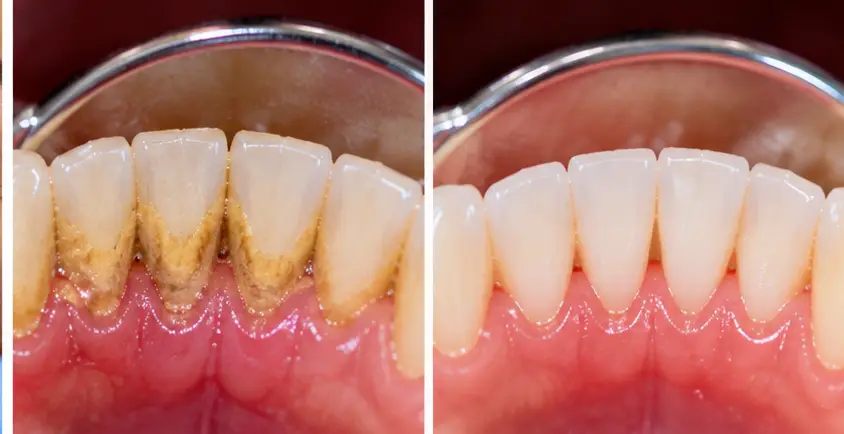
Do you feel a hard or rough deposit on your teeth, for example behind the lower front teeth? This may be tartar. Tartar develops when dental plaque remains on the teeth for a longer period and calcifies.
Once formed, you can no longer properly remove tartar yourself with a toothbrush. A dentist or dental hygienist can remove this during a professional dental cleaning.
But why does one person get much more tartar than another? Does removing tartar hurt? And how often is a professional cleaning actually necessary?
In this article, we explain how tartar develops, how we remove it, and what you can do yourself to limit new formation as much as possible.
What is tartar?
Dental plaque is constantly forming on your teeth and molars. This is a soft layer containing bacteria, among other things.
When plaque is not sufficiently removed, minerals from the saliva can cause this plaque to calcify. The soft layer then turns into a hard deposit: tartar.
Tartar can be located both above and below the gum line.
Once calcified, you can no longer simply brush it away.
Where does tartar develop most often?
In principle, tartar can develop in various places in the mouth, but some areas are more susceptible to it.
A well-known spot is the inside of the lower front teeth. Tartar can also develop relatively easily around the upper molars.
This is partly due to the location of the salivary gland openings.
In addition, tartar can develop in hard-to-reach places where plaque regularly remains during brushing.
Why does one person get more tartar than another?
The amount of tartar varies greatly per person.
This depends, among other things, on the composition and amount of saliva, daily oral care, the position of teeth and molars, and how easily certain places can be reached during brushing.
Even when you brush well, tartar can still develop.
The goal of good oral hygiene is primarily to remove plaque before it has the chance to calcify.
Is tartar the same as plaque?
No. This distinction is important.
Plaque is soft and can be removed daily with a toothbrush and suitable aids.
Tartar is calcified plaque. This deposit is much more firmly attached to the tooth surface and can no longer be effectively removed with normal tooth brushing.
This is precisely why daily oral care is so important: you try to remove plaque before it becomes tartar.
Is tartar harmful to your teeth?
Tartar does not cause a cavity in a tooth in the same way as caries.
The main problem is that it forms a rough surface on which plaque can easily accumulate. This makes it more difficult to keep the area clean yourself.
When plaque remains along the gum line for a long time, the gums can become inflamed.
You may then suffer from red, swollen, or bleeding gums.
In patients sensitive to periodontitis, long-term inflammation can eventually also affect the supporting tissue around teeth and molars.
Can you remove tartar yourself?
You can remove plaque yourself. Tartar cannot be removed in a safe and effective way.
Various instruments are available on the internet with which people try to scrape tartar off their teeth themselves. We do not recommend this.
Without proper visibility and knowledge of the teeth, you can damage the gums or tooth surface. Furthermore, tartar can also be present below the gum line, where you cannot reach it properly yourself.
Therefore, have fixed tartar professionally removed.
How is tartar removed?
A professional cleaning does not automatically start with removing everything that is visible.
First, the condition of the teeth and gums is examined. Then it can be determined where tartar is present and what cleaning is required.
The removal can then be done with various instruments.
Step 1: examination of teeth and gums
The dentist or dental hygienist examines where plaque and tartar are present and assesses the condition of the gums.
When there are indications of more extensive gum problems, additional research may be necessary.
Step 2: removing tartar with ultrasonic equipment
An ultrasonic instrument can be used to remove tartar.
The tip of the instrument makes rapid vibrating movements that can loosen hard deposits from the tooth surface.
During use, water is added to cool and rinse the instrument and the treated area.
Step 3: manual cleaning
In addition to ultrasonic equipment, hand instruments can be used.
These allow the practitioner to accurately remove tartar in specific or hard-to-reach places.
Often, different techniques are combined during the same treatment.
Step 4: additional cleaning if necessary
After removing tartar, deposits may still be present on the tooth surface.
Depending on the situation, additional cleaning or polishing can be performed.
The goal is a clean tooth surface that you can then maintain as well as possible yourself.
Does removing tartar hurt?
That varies per person.
When the gums are healthy and there is relatively little tartar present, many people experience a professional cleaning primarily as a vibrating, scratching, or sensitive sensation.
When the gums are inflamed, tartar is present deeper under the gums, or teeth have sensitive necks, the treatment can be significantly more sensitive.
Therefore, please indicate if you experience pain during the treatment.
For more extensive or sensitive treatments, it can be discussed whether local anesthesia is desirable.
Why do my gums bleed during tartar removal?
When gums are inflamed, they can bleed easily when touched.
As a result, blood may be visible during a professional dental cleaning, especially in places where there is a lot of inflammation.
This does not automatically mean that the practitioner has damaged the gums.
The goal of the treatment is precisely to reduce the factors that maintain the inflammation and to ensure that you can keep the relevant areas cleaner at home.
Can teeth be sensitive after tartar removal?
Yes, that can occur temporarily.
When tartar has been present around teeth or along exposed tooth necks for a longer period, these surfaces may feel more sensitive after removal.
You may notice this, for example, with cold drinks or during brushing.
Inflamed gums can also be sensitive for a short time after an extensive cleaning.
If the sensitivity is severe or does not decrease, please contact the dentist or dental hygienist.
Do you get larger spaces between your teeth after removing tartar?
Some patients feel after an extensive cleaning that larger spaces have suddenly appeared between their teeth.
Tartar may have partially filled these spaces. Additionally, inflamed gums can be swollen. When the tartar is removed and the inflammation decreases, existing spaces sometimes become more visible.
The cleaning has not suddenly removed healthy tooth parts; the underlying situation becomes more visible.
In the case of gum problems, receded or lost supporting tissue can also play a role.
Do teeth become whiter by removing tartar?
A professional dental cleaning is not a whitening treatment.
However, tartar and superficial deposits can make the teeth appear darker or yellower. When these are removed, the teeth can appear cleaner and sometimes also optically lighter.
The natural color of the tooth tissue does not change, however, as it does with teeth whitening.
If you actually want to make your natural tooth color lighter, that is a different treatment.
How long does tartar removal take?
The treatment time depends on how much tartar is present and on the health of the gums.
With a limited amount, the cleaning can be relatively short.
When a lot of tartar is present, the gums are severely inflamed, or there are periodontal problems, a more extensive treatment may be necessary. Sometimes this is divided over several appointments.
Therefore, no standard treatment time can be given for every patient in advance.
How often should tartar be removed?
There is no fixed rule that everyone must have tartar removed once or twice a year, for example.
Some people develop hardly any tartar, while others get clear deposits again within a relatively short time.
The health of the gums also plays a role. Someone with an increased risk of periodontal problems may need more intensive professional guidance than someone with healthy gums and little tartar.
The dentist or dental hygienist can therefore advise a check-up and cleaning interval that suits your situation.
What happens if tartar is not removed?
When tartar remains, plaque can easily accumulate around the rough surface.
This can make it more difficult to get gum inflammation under control.
With gingivitis, the inflammation is limited to the gums. When the supporting tissue around the teeth is also affected in susceptible patients, we speak of periodontitis.
Periodontitis can eventually lead to loss of jawbone and support around teeth and molars.
Therefore, not only is the removal of tartar important, but especially keeping the gums healthy in the long term.
How do you prevent tartar from returning quickly?
Complete prevention is not possible for everyone, but good daily oral care can limit the amount of plaque and thus the formation of tartar.
Brush carefully twice a day with fluoride toothpaste and pay attention to the gum line.
In addition, clean between teeth and molars where necessary. For many adults, interdental brushes are suitable for this, but the correct size varies per set of teeth.
Your dental hygienist can show you which places need extra attention and which aids are suitable for this.
What is the difference between a regular dental cleaning and a periodontal treatment?
Not every professional cleaning is the same.
For someone with healthy gums and some superficial tartar, a relatively simple dental cleaning may be sufficient.
With periodontitis, the problems are located deeper around teeth and molars. In that case, more extensive research is needed and a structured periodontal treatment plan may be advised.
Therefore, it is important not only to ask “how much tartar do I have?”, but also to look at the health of the gums and the supporting tissue.
Tartar removal at the dental hygienist in Leiden
Do you suffer from tartar, bleeding gums, or do your teeth feel rough?
At We Smile Tandartsen in Leiden, our dental hygienist can assess your gums and professionally remove plaque and tartar.
You will also receive personal advice on brushing and cleaning between your teeth and molars. The goal is not just to clean your teeth once, but especially to ensure that you can keep them healthy as well as possible yourself afterwards.
When there are indications of more extensive gum problems, we can assess what further treatment is required.
Would you like to have your teeth professionally cleaned? Then make an appointment with our dental hygienist.