


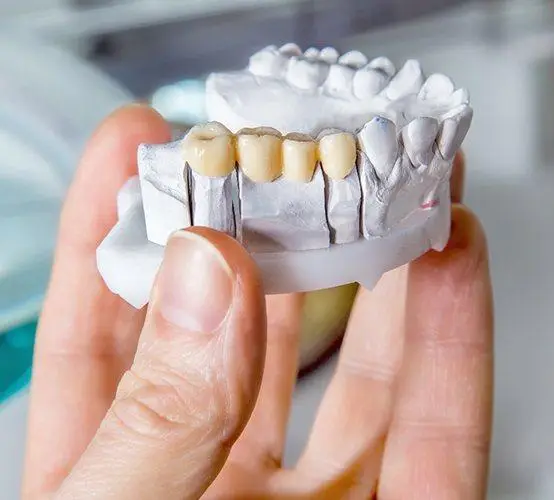
When a tooth or molar is missing, a gap is created in the dentition. Depending on the situation, this space can be filled with a dental bridge. A bridge is a fixed dental restoration that can replace one or sometimes several missing teeth or molars.
Unlike a removable prosthesis, a bridge is fixed in the mouth. The bridge can be supported by teeth or molars adjacent to the empty space. In other situations, a bridge can be placed on implants.
But when is a bridge a good solution? How is it made and what is the difference between a bridge and an implant? We explain it step by step below.
What exactly is a dental bridge?
A traditional dental bridge consists of several parts.
On either side of the missing tooth are the so-called abutments. These are teeth or molars on which crowns are placed. Between these crowns is an artificial tooth, also called a pontic, which fills the empty space.
The various parts together form one fixed construction.
A bridge is permanently attached, so you cannot remove it from your mouth yourself, as is the case with a removable dental prosthesis.
When might a bridge be necessary?
A bridge can be considered when one or more teeth or molars are missing and you want to have the open space restored.
A missing tooth can have various consequences. Depending on the location, you may, for example, experience problems with chewing or with the appearance of your teeth. Also, surrounding teeth and molars can change position over time.
Whether a bridge is suitable depends, among other things, on the location of the missing tooth, the condition of the surrounding teeth, your gums, the bite, and the amount of available space.
Therefore, the entire area is first assessed before a treatment is advised.
What types of dental bridges are there?
Not every bridge is the same.
The classic tooth-supported bridge is supported by teeth or molars on both sides of the missing tooth. These abutments are prepared to support the bridge.
In addition, there are other constructions, such as an adhesive bridge. In this case, an artificial tooth can be attached to one or more adjacent teeth using a different fixation method. This is not possible in every situation.
When several teeth are missing, an implant-supported bridge can also be applied in certain situations.
Which construction is suitable depends heavily on the individual situation.
How is a dental bridge placed?
Creating a traditional dental bridge usually involves several steps.
Step 1: examination and treatment plan
First, the dentist examines the teeth, molars, and gums surrounding the empty space.
The abutments must be sufficiently suitable to support the bridge. If necessary, X-rays are used to obtain additional information.
The options are then discussed with you.
Step 2: preparing the abutments
When a traditional bridge is chosen, the teeth or molars that serve as abutments are prepared.
For this purpose, tooth tissue is ground down to create sufficient space for the crowns that are part of the bridge.
This is done under local anesthesia when necessary.
Step 3: digital scan or impression
Next, the exact shape and position of the teeth must be recorded.
At We Smile Tandartsen, we can use a digital 3D scan of the teeth for this in suitable situations.
Based on this information, the dental laboratory can manufacture the bridge.
Step 4: temporary restoration
Because manufacturing the final bridge takes time, a temporary restoration may be placed depending on the treatment.
This protects the prepared teeth until the final bridge is ready.
Step 5: placing the final bridge
When the bridge is ready, the dentist checks, among other things, the fit, connection, shape, and bite.
When everything is as desired, the bridge can be permanently attached.
You will then receive instructions on how to keep the new construction clean.
Do healthy teeth need to be ground down for a bridge?
This is an important disadvantage to consider when choosing between a traditional bridge and other solutions.
For a conventional tooth-supported bridge, the abutments must be prepared. This means that tooth tissue is removed from these teeth or molars to make room for the crowns.
When the adjacent teeth already have large fillings or crowns, a bridge can therefore be a logical choice in some situations.
If the teeth next to the empty space are completely intact, the preservation of healthy tooth tissue may be a reason to discuss other possibilities.
Therefore, the choice for a bridge must always be made on a case-by-case basis.
What is the difference between a bridge and an implant?
Both a bridge and an implant can be used to replace a missing tooth, but the way they do so differs.
A traditional bridge uses adjacent teeth for support. With an implant, an implant is placed in the jawbone, on which a crown can later be attached. The adjacent teeth usually do not need to be ground down as abutments for this.
On the other hand, placing an implant is a surgical treatment and requires sufficient healthy jawbone and gums. An implant process also usually takes longer.
A bridge can be attractive in certain situations when the adjacent teeth already require extensive restoration anyway.
Therefore, there is no solution that is automatically better for everyone.
Is a bridge the same as a crown?
No, although they are closely related.
A crown covers one existing tooth or molar and is used, for example, when a tooth is severely damaged or weakened.
A bridge spans a space where one or more teeth are missing. In a traditional bridge, crowns on the abutments are connected to each other by one or more artificial teeth.
A bridge can therefore consist of several connected parts.
Can you eat normally with a dental bridge?
When the bridge functions well and you are used to it, you can usually chew normally with it.
Immediately after placement, the new construction may feel a bit different. Your tongue and bite sometimes need to get used to the changed shape.
If you feel that the bridge is too high when biting down or if you experience persistent pain, it is wise to have this checked.
How do you clean a bridge properly?
Good oral hygiene is very important for the lifespan of a bridge.
The artificial tooth itself cannot get a cavity, but the teeth supporting the bridge can. The gums around the bridge can also become inflamed.
Brush therefore carefully along the edges of the bridge and the gum line.
You cannot reach under the pontic with a regular toothbrush. Depending on the space, interdental brushes or special floss can be used for this.
The dentist or dental hygienist can show you which method and which size of tool are suitable for your bridge.
How long does a dental bridge last?
There is no fixed lifespan for it.
A well-made and well-maintained bridge can function for many years, but exactly how long differs per person and per situation.
Among other things, the condition of the abutments, oral hygiene, load on the bridge, grinding or clenching, gum problems, and the development of new caries can influence the lifespan.
Therefore, I would not present the current phrase “average of 10 to 15 years or longer” as a guarantee or firm expectation.
Can a cavity develop under a bridge?
Yes.
The bridge itself consists of artificial material, but the abutments under a tooth-supported bridge are natural teeth or molars.
Plaque can remain especially at the transition between the bridge and the tooth. If bacteria are present there for a long time, caries can develop.
Good daily cleaning and regular check-ups therefore remain important, even when the bridge itself feels problem-free.
What happens if a bridge comes loose?
A bridge should be firmly attached. If it moves or comes loose, you must have it assessed.
Do not try to fix a loose bridge yourself with household glue or other means. The dentist must first assess why the bridge has come loose and what the condition of the underlying abutments is.
Take the bridge with you if it has come completely out of the mouth.
Is a bridge suitable for everyone?
No. The teeth or implants that must support the bridge must be suitable for that purpose.
The condition of the gums, the bite, available space, and oral hygiene also play a role.
If the abutments are not strong enough or if there are active gum problems, another treatment may be needed first, or a different solution may be more suitable.
What alternatives are there for a bridge?
A missing tooth does not automatically have to be replaced with a bridge.
Depending on the situation, for example, an implant with a crown, a removable restoration, or in some cases leaving the space untreated can be considered.
Each option has its own advantages and disadvantages.
The right choice therefore depends not only on what is technically possible, but also on your teeth, wishes, health, and expectations.
Advice on a dental bridge in Leiden
Is a tooth or molar missing and would you like to know what the options are for replacing it?
At We Smile Tandartsen in Leiden, we can examine your teeth and discuss the various options with you. If a dental bridge is suitable, we look at the condition of the surrounding teeth and the gums, among other things.
For the manufacture of crowns and bridges, we can use a digital scan of the teeth.
If an implant might be a better option, we can also discuss this with you and, if necessary, refer you for implantological treatment.
Would you like to know which solution fits your teeth? Then make an appointment for personal advice.